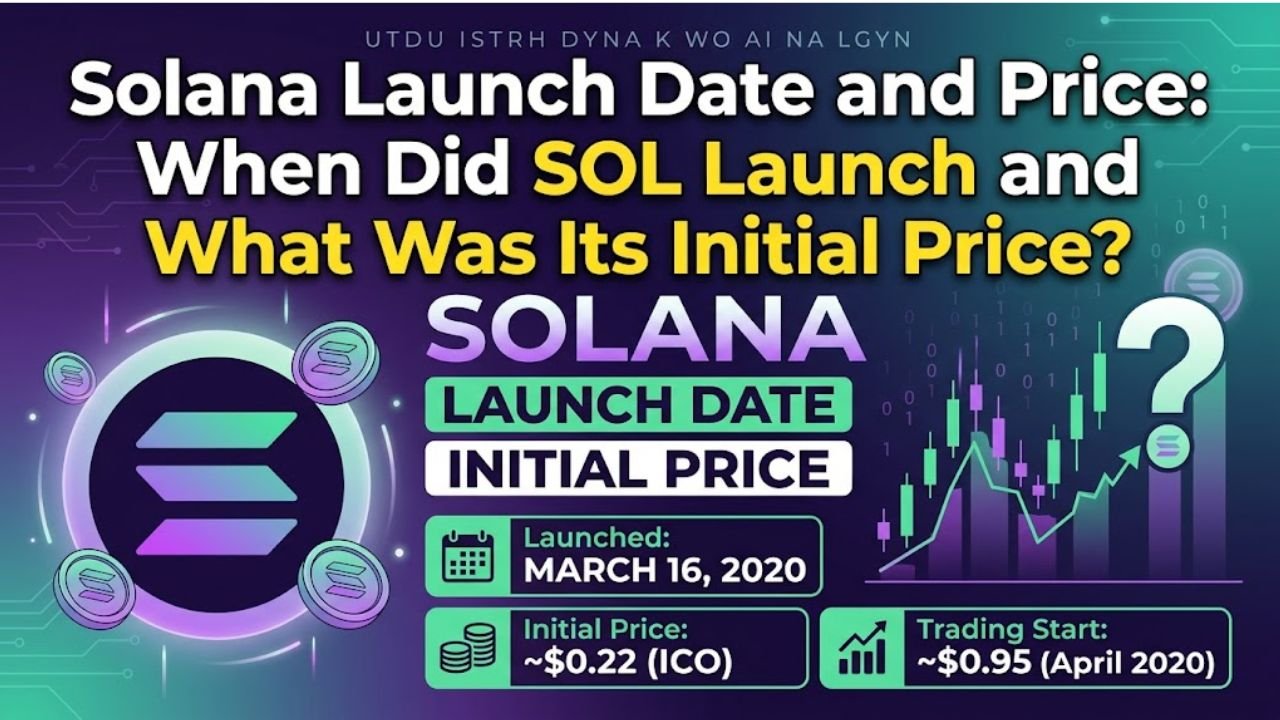
Solana Launch Date and Price
Solana is now one of the most recognized Layer-1 blockchain networks, but SOL did not start anywhere near its current market value. The Solana launch date was March 16, 2020, when Solana Mainnet Beta was officially initialized, while its public CoinList auction later sold SOL at a clearing price of $0.22 per token.
For anyone researching the Solana launch date and price, these two dates and prices can sometimes be confusing because the network launch, token auction, and first exchange trading happened at different times. This guide explains the complete timeline, SOL’s initial price, early performance, major milestones, and what the launch history means for investors today.
Solana Launch Date and Initial Price at a Glance
| Solana Detail | Information |
|---|---|
| Blockchain | Solana |
| Native Token | SOL |
| Mainnet Beta Launch Date | March 16, 2020 |
| Public Token Auction | March 2020 |
| CoinList Auction Clearing Price | $0.22 per SOL |
| Tokens Sold in Public Auction | 8 million SOL |
| Auction Funds Raised | $1.76 million |
| First Broad Trading Period | April 2020 |
| Blockchain Type | Layer-1 |
| Key Technology | Proof of History (PoH) |
| Main Use Cases | DeFi, NFTs, payments, apps, gaming and Web3 |
The Solana Foundation itself states that Solana Mainnet Beta launched on March 16, 2020. Its historical documentation also records the CoinList public auction, where 8 million SOL were sold with a clearing price of $0.22.
When Did Solana Launch?
What was the official Solana launch date?
The official Solana Mainnet Beta launch date was March 16, 2020.
This was the point at which the network moved from development and testing into its Mainnet Beta phase. Solana’s own historical material describes March 2020 as the moment when the Mainnet Beta network was initialized with help from validators around the world.
That distinction matters because some websites refer to the SOL token sale as its “launch.” Technically, the blockchain launch and token auction were separate events.
When was the Solana token sale?
The public Solana token auction took place in March 2020 through CoinList.
Solana reported that the auction opened on March 23, 2020, and sold all 8 million available SOL tokens in approximately six hours. The auction had a final clearing price of $0.22 per SOL and raised approximately $1.76 million.
So, if someone asks for the Solana ICO price, the commonly cited figure is $0.22.
Did Solana launch in 2017 or 2018?
No. Solana’s development history goes back further than its mainnet launch.
Anatoly Yakovenko published the Proof of History concept in 2017, while development and testing continued through 2018 and 2019. The network eventually reached its Mainnet Beta launch in March 2020.
That is why you may see 2017, 2018, 2019 and 2020 mentioned in Solana’s history. They represent different development milestones rather than one single launch event.
What Was Solana’s Initial Price?
Solana launch price vs ICO price
The answer depends on what you mean by “launch price.”
If you mean the public token sale price, SOL was sold at $0.22 during the March 2020 CoinList auction. Solana’s official announcement confirms that 8 million tokens were sold at a $0.22 clearing price.
If you mean the price when SOL became available for broader exchange trading, the number was different. Historical market data indicates that SOL moved above approximately $0.80 during its first broad trading period in April 2020.
This difference explains why articles sometimes give different “Solana launch prices.”
How much was $100 worth at the Solana launch?
At the $0.22 public auction price, a hypothetical $100 purchase would have bought approximately:
$100 ÷ $0.22 = 454.54 SOL
That calculation does not include fees or any restrictions associated with the original auction.
This is one reason Solana’s launch price attracts so much attention. The token started at a very low public auction valuation compared with the prices it reached during later crypto cycles.
However, this example should not be interpreted as a guaranteed investment return. Early token-sale prices, exchange prices and later market prices are not directly comparable because liquidity, supply, market conditions and token availability changed substantially over time.
Solana Price History After Launch
What happened to SOL after its launch?
Solana Launch Date and Price did not immediately become a major cryptocurrency.
After its 2020 launch, Solana gradually developed its ecosystem while the broader cryptocurrency market experienced several different cycles. The network’s technology attracted developers interested in high-throughput applications, decentralized finance and other Web3 use cases.
Historical price data shows that SOL was trading below $1 during its early market period before experiencing much larger moves during the 2021 crypto bull market.
The contrast is striking: the public auction price was $0.22, while the token later traded at hundreds of dollars.
Solana’s 2021 growth
The 2021 crypto bull market became a major turning point for Solana.
SOL attracted increasing attention as developers and users explored decentralized exchanges, NFT applications and other projects built on the network. The combination of fast transaction processing and comparatively low transaction costs helped Solana establish a distinct position among competing Layer-1 networks.
The price appreciation during this period was not caused by one single factor. Crypto liquidity, market sentiment, ecosystem growth, developer activity and speculation all contributed to the broader move.
Solana’s 2022 crash and recovery
Like most cryptocurrencies, SOL experienced a severe decline during the 2022 bear market.
The fall demonstrates an important lesson for anyone studying Solana’s launch price: a low starting price does not automatically make an asset a good investment.
SOL eventually recovered strongly during the following market cycle. CoinLore’s historical data places Solana’s all-time high around January 2025, illustrating how dramatically the token’s market valuation changed from its original public auction price.
Why Was Solana Created?
What problem does Solana solve?
Solana was designed as a high-performance Layer-1 blockchain capable of supporting applications that require substantial transaction throughput.
One of its best-known innovations is Proof of History, which provides a cryptographic way of establishing the passage of time between events on the network.
Solana’s architecture also includes technologies such as Sealevel, Turbine and Cloudbreak. The project describes these components as part of its approach to scaling blockchain performance.
The basic idea is straightforward: instead of treating blockchain scalability as a problem that can only be solved by adding layers on top, Solana attempted to build a high-performance base network from the ground up.
What is SOL used for?
Solana Launch Date and Price is the native cryptocurrency of the Solana network.
Users can use SOL to pay network fees, participate in staking and interact with applications operating on Solana.
SOL also plays an important role in the network’s economic model because validators and delegators use the token in the process of securing the blockchain.
Why is Solana different from Bitcoin and Ethereum?
Bitcoin was primarily designed as decentralized digital money and a store-of-value-oriented network.
Ethereum developed into a general-purpose smart-contract platform and introduced a broad ecosystem of decentralized applications.
Solana also operates as a smart-contract Layer-1, but its architecture emphasizes high throughput and low-latency transaction processing.
That difference is one reason Solana has become particularly prominent in areas such as decentralized exchanges, NFTs, consumer applications and other high-volume blockchain activity.
Solana Launch Price vs Solana Launch Date and Price
What is the current Solana price?
SOL’s market price changes continuously because cryptocurrency markets trade 24 hours a day.
Recent August 2026 market data has placed SOL in roughly the $70–$80 range, although the exact price can change significantly within hours. For example, market reporting around August 15, 2026 has placed SOL near $75.
For an exact live price, investors should check a reputable cryptocurrency exchange or market-data platform immediately before making a transaction.
The more useful comparison is the historical one:
Public auction price: $0.22
Mainnet Beta launch: March 16, 2020
Recent August 2026 price: roughly $75, subject to live market movement
That represents an enormous increase from the original public auction price, but it also came with substantial volatility.
How much has Solana increased since launch?
Using $0.22 as the reference point and approximately $75 as an illustrative August 2026 market price:
$75 ÷ $0.22 ≈ 341 times
In other words, a token purchased at exactly $0.22 and valued at $75 would have increased by roughly 34,000% before accounting for fees, taxes, token restrictions and the practical difficulty of buying and holding the original auction allocation.
Historical market-data providers report similar hundreds-of-times growth from the ICO price.
But there is a crucial caveat: this is a simple price comparison, not a realistic investment-return calculation. Investors could not necessarily buy unlimited SOL at $0.22, and the token’s liquidity, circulating supply and market structure changed over time.
Solana Tokenomics and Early Distribution
How many SOL tokens were initially created?
Solana’s genesis block instantiated 500 million SOL in March 2020, according to research from Helius covering the network’s early tokenomics.
The distribution was divided among several categories, including community reserves, seed investors, founding investors, the team, foundation, validators and the public auction.
One historical tokenomics breakdown lists the public auction allocation at approximately 1.6% of the original distribution, while community reserve represented a much larger share.
Why does token supply matter for price?
Solana Launch Date and Price cannot be analyzed properly without considering supply.
Imagine two cryptocurrencies both trading at $100. If one has 10 million tokens and the other has 10 billion, their market capitalizations are completely different.
This is why experienced crypto analysts examine market capitalization, circulating supply, fully diluted valuation, token unlocks and inflation, rather than looking only at the coin’s individual price.
Solana’s early token distribution and subsequent issuance are therefore essential parts of understanding its long-term valuation.
What Can Solana’s Launch History Tell Investors?
Does a low launch price mean SOL is still cheap?
Not necessarily.
A cryptocurrency’s price per coin is not the same thing as its valuation. SOL at $75 can theoretically be more expensive relative to its fundamentals than another token at $0.50.
The correct comparison requires market capitalization, circulating supply, network activity, adoption and future supply.
This is one of the biggest mistakes new crypto investors make: they see a coin priced at a few cents and assume it has more room to grow than a coin priced at dozens of dollars.
What factors affect Solana’s future price?
Several variables can influence SOL’s valuation:
- Overall Bitcoin and cryptocurrency market direction
- Solana network usage and transaction activity
- Developer and application growth
- DeFi and stablecoin activity
- Institutional demand
- Network reliability and upgrades
- SOL supply and inflation
- Regulatory developments
- Investor sentiment and liquidity
No single factor determines the future Solana Launch Date and Price (SOL price).
A strong network can still experience a major price decline during a broad crypto bear market. Conversely, improving adoption combined with favorable market liquidity can create powerful upside during a bull cycle.
Is Solana a good long-term investment?
There is no universal answer.
From a technology perspective, Solana has established itself as a major Layer-1 network with a substantial ecosystem. Its historical growth from a $0.22 public auction price to a much higher market valuation shows the scale of its adoption and market interest.
At the same time, SOL remains a volatile cryptocurrency. Past performance does not guarantee future returns.
A sensible investor should evaluate Solana alongside portfolio risk, investment horizon, personal financial circumstances and the broader crypto market rather than relying on its historical launch price alone.
Frequently Asked Questions About Solana Launch Date and Price
What was Solana’s launch date?
Solana Mainnet Beta officially launched on March 16, 2020.
What was Solana’s launch price?
The public CoinList auction had a clearing price of $0.22 per SOL in March 2020.
Was Solana launched in 2017?
No. The Proof of History concept dates back to 2017, but Solana’s Mainnet Beta launched in March 2020.
How much did Solana raise in its public launch auction?
The CoinList auction raised approximately $1.76 million by selling 8 million SOL at a $0.22 clearing price.
When did Solana start trading?
SOL became broadly available for cryptocurrency trading shortly after the March 2020 launch, with historical data showing it trading above approximately $0.80 during its first broad trading period in April 2020.
What is Solana’s all-time high?
SOL reached its historical peak during the 2025 market cycle. Market-data sources place the high around January 2025, at roughly $294–$295.
Can SOL reach a new all-time high?
It is possible, but nobody can reliably guarantee a future price target. Reaching a new high would depend on factors such as crypto-market liquidity, Solana adoption, network activity, supply dynamics and overall investor demand.
Final Takeaway
The Solana Launch Date and Price was March 16, 2020, when the Mainnet Beta network was initialized. Its public CoinList token auction followed in March 2020, with SOL selling at a $0.22 clearing price.
That $0.22 figure has become an important reference point in Solana’s history because SOL later experienced one of the most dramatic growth stories among major Layer-1 cryptocurrencies.
Still, the launch price should be viewed as historical context rather than a prediction of where SOL will go next. For anyone researching Solana Launch Date and Price, the smartest approach is to combine the historical timeline with current market capitalization, circulating supply, network activity, ecosystem adoption and broader crypto-market conditions.