
BISP 8171 New Registration 2026: Complete Guide to Eligibility, CNIC Check and Registration
BISP 8171 New Registration
The Benazir Income Support Programme (BISP) is one of Pakistan’s major social protection initiatives, designed to provide financial assistance to eligible low-income families. In 2026, families who have not previously completed the registration process, households whose information has changed, and applicants who need to update their National Socio-Economic Registry (NSER) records can seek guidance through the programme’s official registration system.
The BISP 8171 New Registration 2026 process is based on household information, identity verification and an assessment of socioeconomic circumstances. Applicants can use the 8171 service to check their status, while households that need a new survey or an update generally have to visit an authorised BISP Tehsil Office or registration centre. The online CNIC check and the actual registration process are two different steps, so understanding this distinction can help applicants avoid unnecessary visits and misleading websites.
Compared with 2025, the main point applicants should understand is that BISP registration relies on the dynamic registry process, which allows eligible households to have missing or outdated information reviewed. However, registration does not automatically guarantee financial assistance, and applicants should not assume that a new payment amount, eligibility threshold or registration deadline applies unless BISP officially confirms it.
This guide explains the BISP 8171 eligibility criteria, CNIC check online, NSER survey, required documents, registration procedure, status messages and important precautions for applicants in 2026, with information that can also help households preparing for 2027.
Also Read ; BISP 8171 September 2026
BISP 8171 New Registration 2026: Key Facts at a Glance
Before starting the registration process, applicants should understand the basic requirements and use the correct official channels. The following table summarises the key information available from BISP’s official guidance.
| Registration detail | Information for 2026 |
|---|---|
| Programme name | Benazir Income Support Programme (BISP) |
| Commonly used service | 8171 |
| Registration system | National Socio-Economic Registry (NSER) and dynamic registry |
| New household survey | Through an authorised BISP registration centre or relevant Tehsil Office |
| CNIC status check | Official 8171 web service or SMS to 8171 |
| Identity document | Valid CNIC for adult applicants |
| Children’s information | B-Form or Child Registration Certificate, where applicable |
| Registration fee | Free |
| Eligibility decision | Based on household information and programme rules |
| Payment confirmation | Must be checked through official BISP communication |
| Official information website | https://www.bisp.gov.pk/ |
| Official BISP helpline | 0800-26477 |
What Is BISP 8171 and How Does the Registration System Work?
BISP 8171 is the commonly used name for the Benazir Income Support Programme’s eligibility and beneficiary communication service. It helps applicants check information about their household’s status and receive official messages regarding their application or assistance. The programme uses socioeconomic information to identify households that meet its eligibility requirements, rather than approving applications simply because someone submits a CNIC number.
The NSER plays an important role in this process. It is a household database used to collect information about family composition and socioeconomic circumstances. According to BISP’s official explanation of its dynamic registry, the system supports updates to household information and registration of households that were previously missed. It also helps keep records relevant when a family’s circumstances change.
In practical terms, a family that has never completed a survey may need to register through an authorised centre, while a previously surveyed household may need to correct its information or wait for the relevant reassessment process. The 8171 service helps applicants check their status, but it does not replace the household survey or the programme’s eligibility assessment.
BISP 8171 Eligibility Criteria 2026: Who Can Apply?
BISP assistance is intended for eligible households experiencing financial hardship. There is no single personal characteristic that guarantees approval because the programme evaluates household circumstances and applies its official eligibility and exclusion rules.
Applicants can use the following points as a general guide when preparing for registration.
- Low-income households: Families facing financial difficulties may request an assessment through the official registration process.
- Women heading households: Women responsible for supporting their families may be considered under the programme’s applicable rules.
- Widows: A widow’s household circumstances can be relevant to vulnerability assessment, but widowhood alone does not guarantee approval.
- Households with dependent children: Family composition and children’s information may be relevant to the socioeconomic assessment and other BISP programmes.
- Families not previously surveyed: Households missing from the registry can contact their Tehsil Office to ask about the appropriate registration procedure.
- Previously registered households: Families whose circumstances or personal records have changed may need to update their information or follow the applicable review process.
Is There a Fixed PMT Score for BISP Registration in 2026?
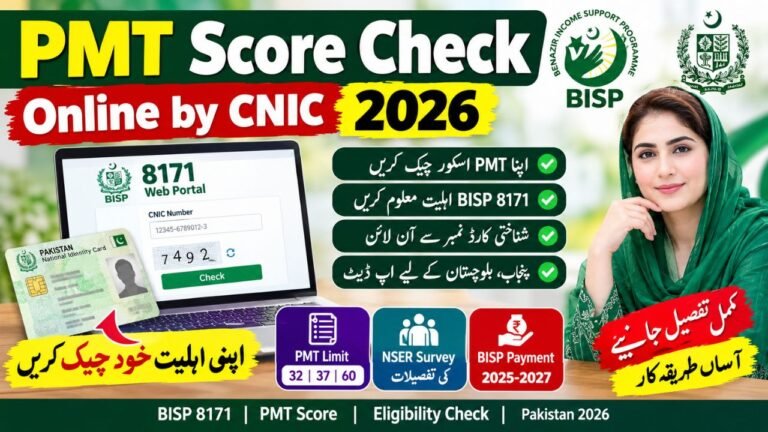
The Poverty Means Test (PMT) score is used in socioeconomic targeting. It is based on information about a household’s circumstances and helps the programme assess eligibility under its applicable rules.
Applicants should be careful with online articles that claim a universal PMT cut-off applies to every BISP applicant in 2026. A particular score may be relevant to a specific programme or eligibility category, but a general threshold should not be treated as a confirmed current rule unless BISP publishes it officially. The same applies to claims that a certain income level, employment status or asset automatically guarantees approval or disqualification.
The safest approach is to provide accurate household information during the NSER survey and ask BISP staff to explain the result if the application is not approved. Do not change or conceal information to influence the assessment, because incorrect records can create verification problems.
BISP 8171 CNIC Check Online 2026: Step-by-Step Guide
Applicants who want to check their existing registration or eligibility status should use the official BISP information channels. A CNIC check is useful for understanding the current record, but it should not be confused with submitting a new application.
Follow these steps:
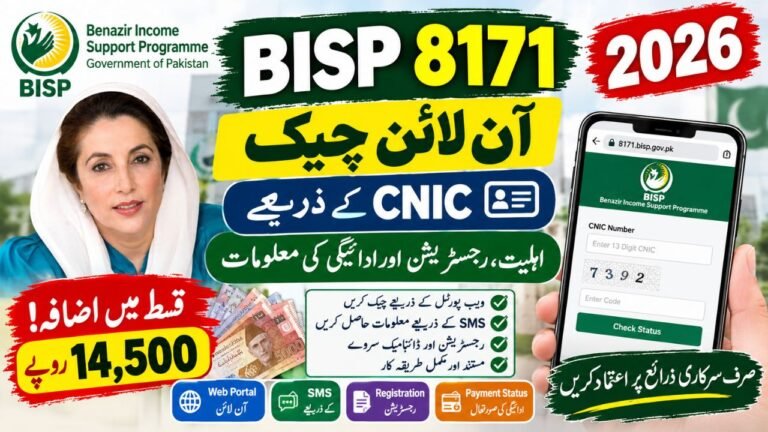
Step 1: Open the official BISP website. Visit https://www.bisp.gov.pk/ and use its official 8171 or beneficiary-status guidance to reach the appropriate service.
Step 2: Enter your CNIC where requested. Use the 13-digit number printed on your identity card. Enter the digits carefully and follow the instructions displayed on the official service.
Step 3: Complete the verification step. If the portal displays a security code or another verification requirement, complete it as instructed.
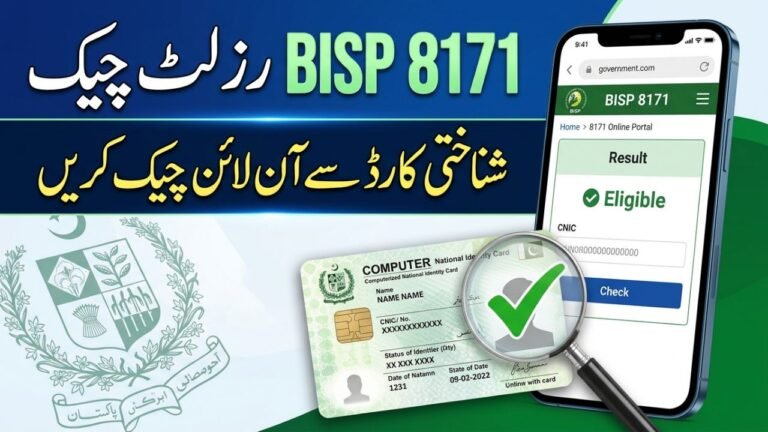
Step 4: Review the response. Read the status message carefully to understand whether your record is available, further verification is needed, or you should contact a BISP office.
Step 5: Follow up if necessary. If the system cannot find your record or the information appears incorrect, contact the relevant Tehsil Office to determine whether you need a new NSER survey, an information update or another review.
The exact appearance of the online service can change over time. If a link is unavailable, begin from the main official BISP website rather than entering your CNIC on an unofficial registration page.
How to Check BISP 8171 Status by SMS
Applicants who have limited internet access can use the official SMS service where available. The general method is to send the applicant’s 13-digit CNIC number to 8171 and wait for the official response.
For example, if your CNIC is represented by a placeholder, the message format is:
1234567890123
The number above is only an example of the format, not a real applicant’s identity number. Send your own CNIC digits without spaces or dashes, and use the official 8171 number.
Keep the following points in mind when checking your BISP status by SMS:
- Make sure you have entered the correct CNIC digits before sending the message.
- Use 8171 rather than a number supplied by an unknown caller or social media account.
- If no response arrives, try again later or ask a BISP office for guidance.
- A message stating that verification is pending does not necessarily mean the application has been rejected.
- Never share your PIN, passwords or banking authentication codes with someone claiming to check your eligibility.
Your mobile number and CNIC information should be handled carefully. A status check should not require you to pay an agent or disclose sensitive account credentials.
BISP 8171 New Registration 2026: How to Apply Through the NSER Survey
For households that need a first-time survey or an authorised update, the main step is to contact the relevant BISP Tehsil Office or registration centre. There is no need to pay a private agent to create a record, and entering a CNIC on a third-party website does not complete BISP registration.
Step 1: Contact Your Nearest BISP Tehsil Office
Ask the office about the appropriate registration centre and whether your household needs a new survey or an update to an existing record. This is particularly important if your family has already been surveyed but your status has not changed.
Step 2: Prepare the Required Documents
Take your original, valid CNIC and the relevant identity documents for other household members. If children are included in your household information, bring their B-Forms or other applicable documents. Staff may explain whether additional documentation is needed for your circumstances.
Step 3: Complete the Household Survey
During the NSER survey, authorised staff collect information about household members and socioeconomic circumstances. Answer the questions honestly and check that the information recorded is accurate. If you do not understand a question, ask the staff member to explain it before responding.
Step 4: Keep Any Receipt or Reference Information
If the registration centre provides a token receipt or reference, keep it safely. It can help you follow up on your survey or explain your case when you return to the office.
Step 5: Wait for Verification and Check Your Status
After the survey, the information may require further verification and assessment. Check the status through official channels and follow any instructions sent by BISP. Completing the survey is not the same as receiving final approval, so avoid relying on unofficial promises about the result.
Step 6: Ask for a Review if Your Information Is Incorrect
If your household details are outdated or the status appears inconsistent with the information you supplied, visit the relevant office and explain the issue. Staff can advise whether a correction, complaint or other official procedure is appropriate.
Documents Required for BISP 8171 Registration 2026
Preparing the relevant documents before visiting a registration centre can make the process easier. Requirements may vary depending on whether you are applying for the first time, correcting an existing record or updating household information.
| Document or information | Why it may be needed |
|---|---|
| Original CNIC | Identity verification for the adult applicant |
| CNIC details of other adult household members | Recording and verifying household information |
| Children’s B-Forms | Confirming the identity and details of children, where applicable |
| Active mobile number | Receiving relevant registration or status messages |
| Existing NSER or survey reference | Helping staff locate an earlier record, if available |
| Relevant supporting documents | Clarifying changes in family or personal circumstances, if requested |
Applicants should confirm any additional requirements with the relevant BISP office. Do not leave original identity documents with an unauthorised person, and do not send photographs of sensitive documents to strangers offering guaranteed registration.
BISP Registration 2025 vs 2026: What Has Changed?
The most useful comparison between 2025 and 2026 is the distinction between checking a record, completing a survey and receiving approval. The dynamic registry approach is designed to support ongoing updates and the inclusion of households that were previously missed, while eligibility continues to depend on the programme’s assessment and applicable rules.
| Topic | General position in 2025 | Position to understand in 2026 |
|---|---|---|
| Household records | Existing NSER records were used for assessment | The dynamic registry supports relevant information updates and registration of missed households |
| New registration | Applicants were directed to authorised registration channels | Applicants should contact an authorised Tehsil Office or registration centre for a survey |
| Online CNIC check | Used to check available beneficiary information | Still distinct from completing a new household survey |
| Eligibility decision | Depended on household circumstances and programme rules | Still requires verification and assessment under applicable rules |
| Registration fee | BISP survey registration was free | The survey remains free under BISP’s official guidance |
| Payment information | Applicants checked official programme announcements | Applicants should verify current payment details instead of relying on old amounts |
| Future registration | Families followed the instructions then in force | Applicants preparing for 2027 should confirm any new rules through official announcements |
This comparison does not mean that every applicant’s process or eligibility changed in 2026. It explains the continuing role of the dynamic registry and the need to use current official instructions. Any specific new deadline, revised PMT threshold or change in payment amount should be supported by a dated official announcement before being presented as fact.
BISP 8171 Payment Status 2026: What Happens After Registration?
After completing the NSER survey, applicants must wait for the relevant verification and eligibility decision. Some households may receive an update through 8171, while others may need to visit their Tehsil Office to clarify missing information or resolve a record mismatch.
It is important to understand that a successful survey does not automatically mean that payment has been approved. The household record must be assessed under the applicable programme rules, and the applicant should follow the instructions provided through official channels.
The following table explains common status situations in simple language. The exact wording shown on the portal or in an SMS may differ.
| Status situation | What it generally means | Recommended next step |
|---|---|---|
| Eligible | The available record indicates eligibility | Follow official payment instructions |
| Verification required | Additional checking may be needed | Contact the relevant BISP office |
| Survey required | A household survey or record update may be necessary | Ask about the NSER registration procedure |
| Record not found | The service could not locate the expected information | Recheck the CNIC and seek official guidance |
| Not eligible | The household has not qualified under the current assessment | Ask BISP whether a review or correction is available |
| Payment not confirmed | Eligibility and payment release may not yet be confirmed | Wait for an official update before visiting a payment centre |
These descriptions are general explanations, not guaranteed translations of every official status message. A beneficiary should rely on the actual response received from BISP and seek clarification when necessary.
BISP 8171 Registration 2026: Important Rules and Fraud Prevention
BISP has repeatedly warned the public that its registration and survey services are free. According to official programme guidance, 8171 is the official number used for BISP messages, and messages from other numbers claiming to provide guaranteed assistance should be treated with caution.
Applicants should keep these precautions in mind:
- Never pay an agent to guarantee BISP registration, eligibility or payment approval.
- Do not trust a website that promises instant approval simply by entering a CNIC number.
- Never share bank PINs, passwords or one-time verification codes with an unknown person.
- Provide accurate household information during the survey and correct any mistakes through authorised staff.
- Keep your survey receipt and any official messages for future reference.
- Do not visit a payment centre solely because of an unverified social media post.
- If someone demands money or makes an unauthorised deduction, report the issue to BISP.
The official BISP helpline is 0800-26477. Applicants can also visit the nearest relevant Tehsil Office for registration guidance and complaints.
BISP 8171 New Registration 2027: What Applicants Should Know
Families planning to apply in 2027 should follow the registration rules and announcements that are officially in force at that time. The dynamic registry provides a mechanism for households to seek registration or updates, but it does not mean that every family can immediately qualify or that a new payment scheme has been announced.
If your household has not been surveyed, you can ask BISP about the appropriate registration procedure. If you have already completed a survey, first check your existing status before requesting another one. BISP has issued guidance that households should not repeatedly request surveys before the applicable interval; existing beneficiaries who are due for recertification should follow the instructions provided by the programme.
Do not rely on unverified claims about a new 2027 registration deadline, a guaranteed monthly income limit, or a revised payment amount. Check the official website and announcements for confirmed updates before making a decision.
Frequently Asked Questions About BISP 8171 Registration 2026
1. How can I register for BISP 8171 in 2026?
Contact your nearest BISP Tehsil Office or authorised registration centre to ask about the NSER household survey. Complete the survey with accurate information and wait for the official eligibility decision.
2. Can I complete BISP new registration online?
The 8171 online service is primarily used for checking status and eligibility information. A new household survey or an authorised record update generally requires the relevant BISP registration process rather than simply filling in an online form.
3. Is BISP 8171 registration free?
Yes. BISP’s official guidance states that registration and survey services are free. You should not pay an agent to complete the survey or promise approval.
4. Which documents are required for BISP registration?
Applicants should generally take their original CNIC and relevant household documents, including children’s B-Forms where applicable. The registration centre can explain whether additional documents are needed for a particular case.
5. Does a CNIC check confirm BISP payment?
No. A CNIC check provides available status information, but it should not be treated as proof that a payment has been released. Follow the official payment notification and instructions.
6. What should I do if my CNIC is not found on 8171?
First, check that the CNIC number is correct. If the system still cannot find your record, contact the nearest BISP Tehsil Office to ask whether a survey or information update is required.
7. Can a previously rejected applicant apply again?
The next step depends on the reason for the decision and the rules that apply to the household. Ask BISP whether a record correction, review or new survey is permitted instead of assuming that immediate re-registration is available.
8. What is the official BISP complaint number?
BISP lists 0800-26477 as its complaint helpline. You can also visit the relevant Tehsil Office for assistance with registration problems, suspected fraud or payment deductions.
Final Words
The BISP 8171 New Registration 2026 process is intended to help eligible low-income households enter or update their records through the official NSER and dynamic registry system. The most important steps are to check your existing CNIC status, prepare the necessary documents, complete the authorised survey if required, and wait for the actual eligibility decision.
Applicants should remember that registration, eligibility and payment are three separate stages. A completed survey does not guarantee approval, and a status check does not necessarily confirm that money is ready for collection. For the most reliable information, use BISP’s official website, follow messages from 8171, and contact the programme’s helpline if you encounter a problem.