Punjab PIVOT Program 2026 – Rs. 1,995 Billion Investment & 162,000 Jobs
Punjab PIVOT Program 2026
Punjab is preparing a major change in its industrial and economic development through the Punjab PIVOT Program 2026. Chief Minister Maryam Nawaz Sharif formally launched this three-year economic transformation plan on 30 October 2026. The programme aims to attract Rs. 1,995 billion in investment, create more than 162,000 direct employment opportunities and increase Punjab’s exports by $6.8 billion over the coming years.
The Punjab government plans to achieve these targets by supporting local industries, improving industrial infrastructure, introducing modern testing facilities, encouraging private investment and helping businesses reach international markets. The plan also covers agriculture, livestock, e-commerce, skills development, tourism and technology.
Unlike a traditional development project that focuses on one sector, this initiative brings several economic activities under one development framework. Its main purpose is to help businesses expand, improve the quality of locally manufactured products and create better employment opportunities across Punjab.
More Read: Ehsaas 8171 Web Portal 2026
What Is the Punjab PIVOT Program 2026?
The Punjab PIVOT Program is a three-year economic development and industrial investment plan for 2026–29. It was designed to improve the province’s industrial capacity, strengthen exports and encourage cooperation between the government and private businesses.
The programme was approved by the Punjab Cabinet during its 37th meeting on 19 October 2026, chaired by Chief Minister Maryam Nawaz Sharif. Its formal launch took place on 30 October 2026 in Lahore, where the government also introduced the STEP portal associated with the initiative.
The Punjab Economic Transformation Program focuses on moving local businesses towards modern production methods, better product standards and international trade. The government wants manufacturers to produce higher-value goods instead of depending only on traditional production and local markets.
The main areas covered by the plan include industrial development, business financing, manufacturing, agricultural processing, digital services, tourism and professional training.
Punjab PIVOT Program Investment Details 2026
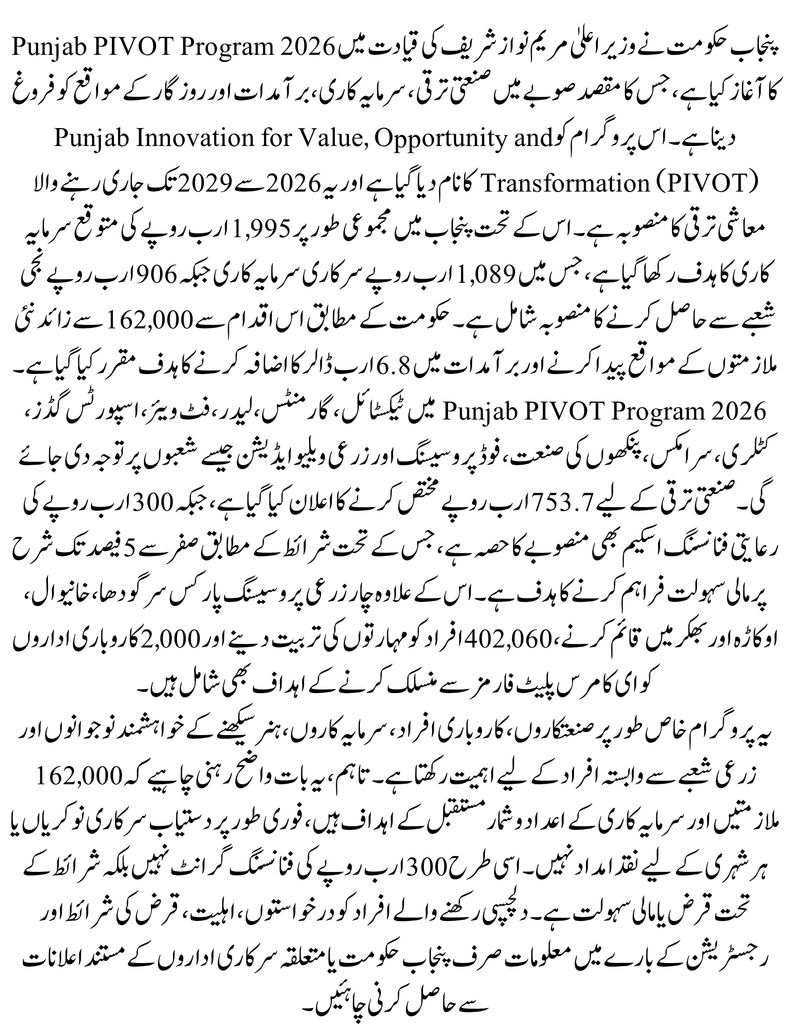
One of the most important features of the Punjab PIVOT Program 2026 is its expected investment of Rs. 1,995 billion. This amount combines public investment from the provincial government and expected investment from private businesses.
The investment structure shows that the government intends to support economic growth through both public funding and private-sector participation.
| Investment Category | Expected Amount |
|---|---|
| Total investment | Rs. 1,995 billion |
| Punjab government investment | Rs. 1,089 billion |
| Private sector investment | Rs. 906 billion |
| Industrial sector allocation | Rs. 753.7 billion |
| Concessional financing under STEP | Rs. 300 billion |
| Expected additional exports | $6.8 billion |
| Expected direct employment | 162,000 jobs |
| Expected people benefiting | More than 1 million |
These figures represent announced programme targets and financial allocations, not completed spending or achieved results.
The Punjab Government Investment component is expected to provide support for industrial infrastructure, business development and other economic projects. At the same time, Punjab Private Sector Investment is intended to encourage companies, manufacturers and investors to expand their operations.
This combination is important because government funding alone cannot meet every development requirement. Private businesses can bring additional capital, technology, production experience and access to international customers.
How Will the Punjab Government Create 162,000 Jobs?
Employment generation is one of the major objectives of the Punjab PIVOT Program. According to the announced plan, the government expects the initiative to create more than 162,000 additional direct jobs.
These Punjab Employment Opportunities 2026 are linked to industrial expansion, manufacturing, agriculture, technology, tourism and other business activities. As companies expand their production and introduce new facilities, they may need additional workers, technicians, engineers, managers and skilled professionals.
The expected employment areas include:
- Manufacturing and industrial production
- Garments and textile businesses
- Leather and footwear industries
- Sports goods production
- Food processing and agricultural businesses
- E-commerce and digital services
- Tourism and hospitality
- Technical and vocational services
The 162,000 Jobs in Punjab figure is a target for the programme period. It does not mean that 162,000 government vacancies have been announced.
People looking for Jobs in Punjab 2026 should understand this difference. The PIVOT programme is an economic development initiative, not a single recruitment advertisement. Employment opportunities are expected to develop as businesses and industrial projects expand.
Punjab PIVOT Program 2026 – Important Facts and Figures
| Key Details | Information |
|---|---|
| Program Name | Punjab Innovation for Value, Opportunity and Transformation (PIVOT) |
| Program Period | 2026–2029 |
| Total Expected Investment | Rs. 1,995 Billion |
| Government Investment | Rs. 1,089 Billion |
| Expected Private Investment | Rs. 906 Billion |
| Expected Job Opportunities | 162,000+ |
| Additional Export Target | $6.8 Billion |
| Industrial Development Allocation | Rs. 753.7 Billion |
| Concessional Financing | Rs. 300 Billion |
| Financing Rate | 0% to 5%, subject to applicable terms |
| Skills Training Target | 402,060 people |
| Solar and Battery Storage Investment | Rs. 50 Billion |
| Machinery Duty Reimbursement | Rs. 50 Billion |
| Businesses Targeted for E-Commerce | 2,000 firms |
| Public Services to Be Digitised | 300 services |
| Agro-Processing Parks | 4 |
| Horticulture Authorities | 20 districts |
| Expected Beneficiaries | More than 1 million people |
Punjab Industrial Development 2026: Major Sectors Included
Industrial development is one of the central parts of this economic plan. Punjab already has established manufacturing centres, but many businesses need better infrastructure, modern technology, quality testing and access to international markets.
Through Punjab Industrial Development 2026, the government intends to improve these areas and help existing industries become more competitive.
1. Sports Goods Testing and Certification
Punjab’s sports goods manufacturing industry needs internationally accepted product standards to compete in overseas markets. Buyers often require proper testing, quality assurance and certification before purchasing products in large quantities.
The programme includes Sports Goods Testing and Certification facilities to help manufacturers improve product quality and meet international requirements.
Better testing services can help local companies identify manufacturing problems, improve product standards and build confidence among international buyers.
2. Material Testing Laboratory for Fan Industry
The fan manufacturing industry is another important part of Punjab’s industrial sector. Manufacturers need reliable testing facilities to check product quality, safety, durability and performance.
A Material Testing Laboratory for Fan Industry is included in the industrial development framework. These facilities are intended to help manufacturers improve their products and meet the requirements of different markets.
The programme also includes testing facilities for other manufacturing sectors, including cutlery, handmade tools and ceramics.
3. Punjab Textile Industry and Garments
The Punjab Textile Industry has an important role in Pakistan’s manufacturing and export economy. Textile and garment businesses require modern machinery, reliable infrastructure, skilled workers and better access to export markets.
The PIVOT framework includes support for garments, textile-related manufacturing and industrial facilities. Plug-and-play facilities are also planned to help businesses start or expand operations with access to essential infrastructure.
This approach can reduce some of the difficulties businesses face when establishing new manufacturing units.
4. Punjab Leather Industry and Footwear
Leather products and footwear are also included in the programme’s manufacturing priorities.
The Punjab Leather Industry can benefit from improved testing, certification, modern production facilities and value addition. These improvements are important for businesses that want to sell products in international markets.
The plan also includes certification services for footwear manufacturers. Better quality control can help local companies meet buyer requirements and improve their export opportunities.
5. Cutlery Manufacturing Industry Pakistan
The cutlery sector is another manufacturing area covered by the initiative. Manufacturers need proper material testing and quality assessment to improve the reliability of their products.
The programme includes modern testing facilities for the cutlery and handmade tools industries. These facilities are intended to support manufacturers in improving production standards and developing products suitable for international buyers.
Punjab Infrastructure Development and Industrial Projects 2026
Industrial growth requires more than financial support. Businesses also need suitable land, electricity, roads, testing facilities, storage and other basic services.
Punjab Infrastructure Development is therefore an important part of the programme. The government plans to improve industrial facilities and support the development of manufacturing clusters.
These facilities can help businesses operate in organised industrial areas instead of spending large amounts on separate infrastructure arrangements.
The main areas include:
- Industrial infrastructure and cluster development
- Plug-and-play facilities for manufacturers
- Modern testing and certification laboratories
- Solar power installations and battery energy storage systems
- Technology upgrades for manufacturing units
- Better facilities for agricultural processing
- Support for existing industrial businesses
The plan also includes financial support for machinery upgrades and industrial modernisation. This can help manufacturers replace outdated equipment, improve production efficiency and reduce operational problems.
These initiatives form part of the wider Punjab Industrial Projects 2026 and Punjab Government Development Projects framework.
Rs. 300 Billion STEP Financing for Businesses
Financing is one of the major challenges for small and large businesses. Companies often need additional capital to purchase machinery, expand factories, improve production or develop new products.
Under the PIVOT framework, the government has announced Rs. 300 billion in concessional financing through the Strategic Trade Enhancement Programme (STEP).
The announced financing structure includes interest rates ranging from zero to 5%, subject to the applicable commercial categories and programme conditions.
This financing is intended to help eligible businesses access comparatively lower-cost capital for industrial expansion and export-related activities.
The STEP initiative is particularly relevant to manufacturers who want to upgrade their facilities, increase production capacity or improve their ability to compete in international markets.
However, the announced financing allocation should not be treated as an unconditional cash grant. Businesses will need to follow the relevant financing terms and eligibility requirements when the applicable arrangements are published.
Punjab Economic Development Through Agriculture and Food Processing
Agriculture is another important part of Punjab’s economy. The province produces different crops, fruits, vegetables and livestock products, but many agricultural businesses need better storage, processing and marketing facilities.
The Punjab Economic Development plan includes agricultural value addition to help farmers and businesses earn more from their products.
Four agro-processing parks are planned in Sargodha, Khanewal, Okara and Bhakkar. These parks are intended to support processing, storage and other value-added activities.
The programme also covers horticulture, floriculture, meat and dairy processing, modern agricultural machinery and improved supply chains.
Instead of selling every agricultural product in its raw form, businesses can process, package and prepare products for markets with higher commercial value.
This approach can create additional business activities in rural areas and support employment beyond traditional farming.
Punjab Manufacturing Industry and Export Growth
The Punjab Manufacturing Industry is expected to receive major attention under the PIVOT initiative. The programme focuses on improving production quality, introducing modern technology and helping local manufacturers compete internationally.
The government has set a target of increasing exports by an additional $6.8 billion over the three-year programme period.
To support this target, the plan includes industrial modernisation, testing laboratories, product certification, export financing and support for value-added manufacturing.
The Punjab Textile Industry, leather, footwear, sports goods, pharmaceuticals, fans, cutlery, steel and ceramics are among the manufacturing value chains covered by the plan.
For exporters, improved certification and testing services can be especially useful because international buyers often require products to meet specific quality and safety standards.
The government also intends to encourage businesses to use digital platforms and e-commerce channels to reach more customers.
E-Commerce and Digital Business Support
Modern businesses increasingly depend on digital platforms to promote products, communicate with customers and complete sales.
The PIVOT plan includes e-commerce and business digitalisation as part of its economic development strategy.
The programme envisages bringing 2,000 firms onto e-commerce platforms and digitising 300 public administrative services through the wider digital business reform framework.
These measures are intended to make business operations easier and improve access to online markets.
Small manufacturers and local businesses may benefit from digital platforms because they can display their products to customers outside their immediate markets.
The programme also aims to simplify administrative processes so businesses can spend more time on production, investment and expansion.
Punjab Economic Growth Projects: What Is Different From Earlier Development Plans?
Punjab has introduced several industrial and economic development initiatives over the years. Earlier programmes focused on individual sectors, infrastructure improvements, business financing or specific industrial areas.
For example, the Punjab Bureau of Statistics publishes industrial production and employment surveys, including historical monthly data for 2025 and available 2026 reporting. These records provide a useful reference for understanding the province’s existing manufacturing activity.
The Punjab Investment Program 2026 takes a broader approach by connecting industrial investment, exports, business financing, agricultural value addition, digital services and skills development under one three-year framework.
The main difference is the scale and combined structure of the announced investment targets.
Rather than treating each industry as a separate development activity, the plan aims to connect manufacturers with testing facilities, financing, modern infrastructure and international markets.
It is important to understand that the Rs. 1,995 billion investment target belongs to the newly announced 2026–29 plan. It should not be confused with earlier investment proposals or treated as money already invested during 2025.
Punjab Investment Projects 2026: Who May Benefit?
The programme is expected to support different groups connected with Punjab’s economy.
Industrial owners and manufacturers: Businesses may benefit from improved infrastructure, testing services, certification and financing opportunities.
Exporters: Companies selling products abroad may benefit from better product standards, export financing and improved access to international markets.
Farmers and agricultural businesses: Agro-processing facilities and value addition can create additional opportunities for agricultural products.
Young people and skilled workers: Industrial expansion, digital businesses and training programmes may create new employment opportunities.
Small and medium businesses: E-commerce, business facilitation and financing arrangements may help eligible companies expand their activities.
The actual benefits will depend on project implementation, financing conditions and the participation of businesses in the relevant sectors.
Important Note About PIVOT Registration, Jobs and Financing
The Punjab PIVOT Program 2026 is a three-year economic development plan, not a public cash distribution scheme or a general government recruitment programme.
The announced target of 162,000 jobs does not mean that applications are currently open for all these positions. Similarly, the Rs. 300 billion STEP financing allocation does not mean every applicant will automatically receive a loan.
The STEP portal was launched as part of the initiative, but readers should check the relevant official government announcements for its application process, participating institutions, business eligibility and financing terms.
No separate public registration deadline, general citizen eligibility list or universal job application form has been established by the launch figures alone.
Businesses should avoid submitting personal information or paying registration fees through unofficial websites or social media links.
Frequently Asked Questions
1. What is the Punjab PIVOT Program 2026?
It is a three-year economic transformation plan for Punjab covering industrial development, private investment, exports, agriculture, technology and employment. Its investment target is Rs. 1,995 billion.
2. How much investment is planned under PIVOT?
The total expected investment is Rs. 1,995 billion, including Rs. 1,089 billion from the Punjab government and Rs. 906 billion from the private sector.
3. How many jobs will the PIVOT programme create?
The government expects the initiative to create more than 162,000 additional direct jobs during the programme period.
4. What is the STEP financing programme?
STEP is the Strategic Trade Enhancement Programme associated with PIVOT. It includes an announced Rs. 300 billion concessional financing arrangement, with rates ranging from zero to 5% for eligible commercial categories, subject to programme conditions.
5. Which industries are included in the PIVOT plan?
The programme covers textiles, garments, sports goods, leather, footwear, pharmaceuticals, fans, cutlery, steel, ceramics and other manufacturing value chains. It also includes agricultural processing, e-commerce and tourism.
6. Will Punjab PIVOT create government jobs?
The programme aims to create direct employment through industrial and economic expansion. However, the 162,000 target is not a list of government vacancies. Separate recruitment advertisements will be needed for specific jobs.
7. Is PIVOT a 2025 or 2026 programme?
The current Punjab PIVOT economic transformation plan was approved in October 2026 and formally launched on 30 October 2026. Its announced planning period is 2026–29.
8. How can businesses get information about PIVOT financing?
Businesses should follow official Punjab government announcements and the STEP portal information for application instructions, eligibility conditions, participating institutions and financing terms.
Conclusion
The Punjab PIVOT Program 2026 introduces a three-year investment and economic development framework with an expected investment of Rs. 1,995 billion and a target of more than 162,000 direct jobs. Its main focus is to improve industrial infrastructure, strengthen manufacturing, support agricultural value addition and increase exports.
The programme also includes concessional financing, modern testing laboratories, digital business facilities and skills development. However, its targets will depend on effective implementation and participation from the private sector.
For businesses, manufacturers, farmers and job seekers, the important next step is to follow official announcements and check the relevant programme conditions instead of relying on unverified registration or employment claims.
Official and Trusted Sources
| Source | Information |
|---|---|
| Associated Press of Pakistan (APP) | Punjab Cabinet approves Rs. 1,995 billion industrial development and export programme |
| Government of Punjab – Planning & Development Board | Punjab Resource Management & Policy Unit – Economic Monitor |
| Punjab Bureau of Statistics | Industrial Production and Employment Statistics |