
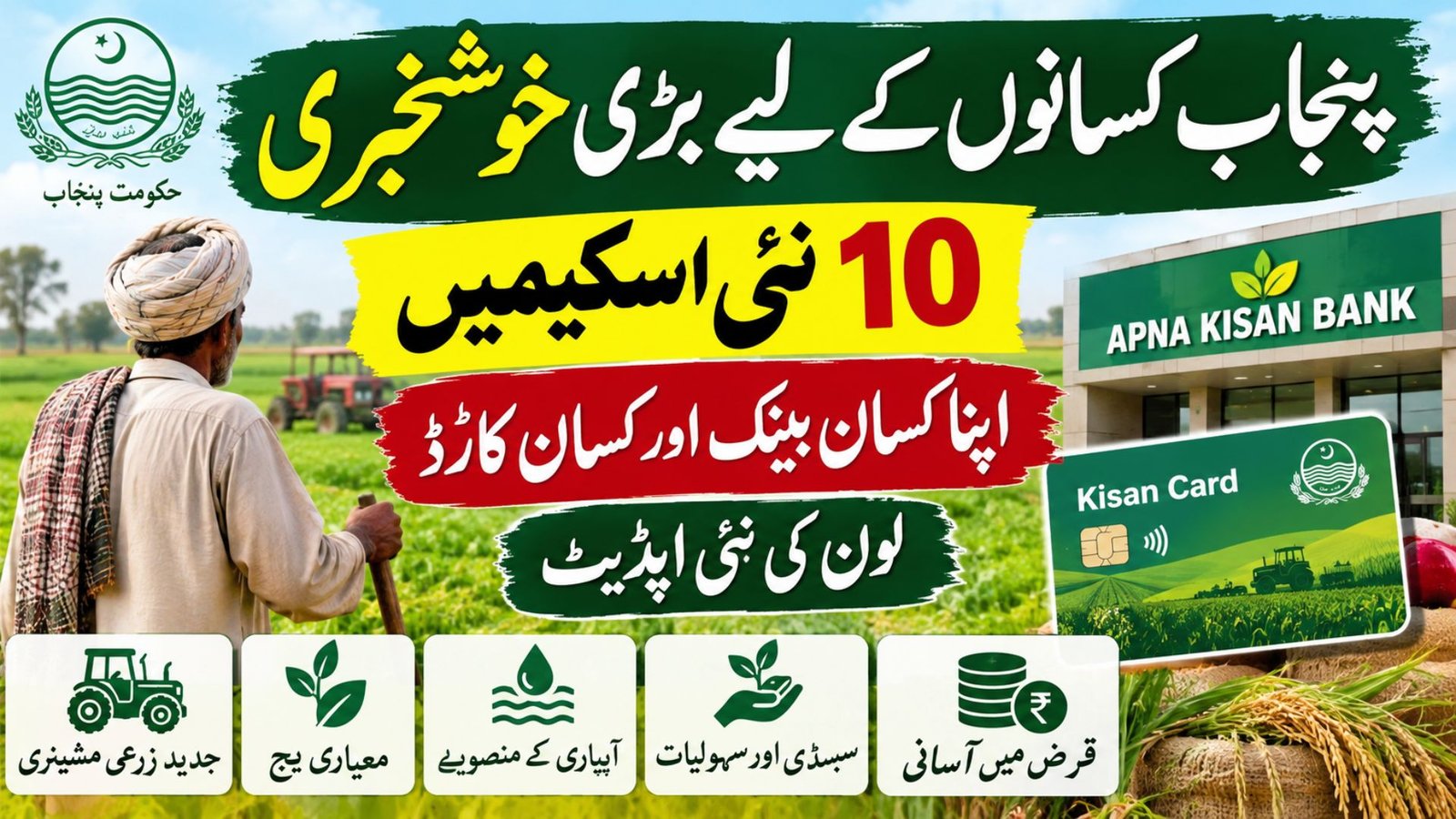
Punjab Farmers Initiatives 2026: 10 New Schemes, Apna Kisan Bank Loan & Kisan Card Update
Apna Kisan Bank Loan & Kisan Card Update
Punjab farmers initiatives 2026 have become an important development for the province’s agricultural sector after Chief Minister Maryam Nawaz Sharif announced a new set of measures on October 28, 2026. The announcements include plans for the first Apna Kisan Bank, higher financing under the Kisan Card, interest-free agricultural loans, a wheat procurement plan, subsidized tractors and additional support for olive cultivation. The government has also highlighted modern farm machinery, water conservation, soil testing and measures to reduce crop losses. TechJuice+1
The new Punjab farmers relief package 2026 aims to address some of the biggest challenges facing farmers, including the rising cost of agricultural inputs, access to affordable credit, irrigation problems and limited facilities for processing and storing crops. These measures build on existing agricultural programmes rather than replacing every earlier scheme. Farmers should therefore understand which benefits have been announced, which programmes are already listed by the Agriculture Department and which details still require formal implementation instructions.
This guide explains the Punjab agriculture initiatives 2026 in simple English, with important figures, comparisons with previous programmes, expected benefits and official sources for checking future updates.

Punjab Farmers Relief Package 2026: Latest Announcements at a Glance
The latest Maryam Nawaz farmers package includes several measures intended to improve agricultural financing, wheat production, mechanisation and water management. The following table summarises the main figures reported on October 28, 2026. TechJuice+1
| Initiative | Announced details | Main purpose |
|---|---|---|
| Apna Kisan Bank | New provincial farmers’ bank announced | Improve access to agricultural finance |
| Interest-free agricultural loans | Up to Rs 10 million at zero markup under the reported financing arrangement | Reduce borrowing costs |
| Kisan Card loan increase | From Rs 30,000 to Rs 33,500 per acre | Help with fertiliser and other eligible farm inputs |
| Wheat support price | Rs 4,500 per 40 kg (one maund) | Support wheat growers |
| Green Tractor Scheme | Subsidized tractor programmes continue | Improve farm mechanisation |
| High-tech machinery | Rs 70 billion allocation reported for mechanisation | Expand access to modern equipment |
| Olive cultivation | Special support package announced | Promote high-value agriculture |
| Soil and water testing | Mobile testing laboratories announced | Improve crop and resource management |
| Irrigation improvements | Canal desilting, watercourse lining and action against water theft | Reduce water losses |
| Agro-processing | Processing, grading and storage projects reported | Reduce post-harvest losses and support exports |
Important: These are announced measures and reported programme figures, not confirmation that every new facility is already accepting applications. The final loan terms, application dates, eligibility rules and implementing institutions should be checked through official government notifications.
1. Apna Kisan Bank Punjab: A New Option for Agricultural Loans
The proposed Apna Kisan Bank Punjab is one of the most prominent parts of the new package. The Punjab government has announced plans to establish a dedicated bank for farmers, with the aim of making agricultural finance easier to access.
Many farmers need money before the sowing season to purchase seeds, fertilisers, pesticides, machinery and fuel. When affordable financing is unavailable, they may have to depend on informal lenders or delay important farm activities. A dedicated farmers’ bank could help address this problem if its financing products are accessible and its application process remains straightforward.
More Read: Maryam Nawaz Loan Scheme 2026
Apna Kisan Bank 2026: Announced Loan Rates
Reports published on October 28 describe the following proposed financing structure.
| Reported loan amount | Reported markup rate |
|---|---|
| Up to Rs 10 million (Rs 1 crore) | 0% |
| Up to Rs 30 million (Rs 3 crore) | 2% |
| Up to Rs 50 million (Rs 5 crore) | 5% |
These figures describe the announced financing arrangement and should not be treated as final bank terms until the government publishes the applicable rules. Farmers should also confirm whether the rates are annual, what collateral or guarantees may be required, which expenses qualify and how repayment will work.
The interest-free agricultural loans proposal could be particularly useful for farmers who need funds for crop production or approved agricultural investment. However, a farmer should not assume that the entire amount is automatically available to every applicant.
The government still needs to provide clear information about the bank’s launch, application method, eligibility conditions and loan disbursement process.
2. Kisan Card Scheme 2026: Loan Limit Increased to Rs 33,500 per Acre
The Kisan Card scheme is an existing Punjab government programme that provides eligible farmers with access to financing for agricultural inputs. It was introduced before the October 2026 announcements, so the new loan increase should be understood as an expansion of an existing facility rather than the launch of a completely new scheme.
According to reports published on October 28, 2026, the Kisan Card loan limit is being increased by Rs 3,500 per acre, from Rs 30,000 to Rs 33,500 per acre. The reported change is intended to provide additional financial support for fertiliser purchases, including DAP. TechJuice+1
Kisan Card Loan Limit Comparison 2026
| Details | Amount |
|---|---|
| Previous reported limit per acre | Rs 30,000 |
| New announced limit per acre | Rs 33,500 |
| Increase per acre | Rs 3,500 |
The Punjab Agriculture Department’s published Phase-II plan for 2026–27 to 2027–28 separately lists interest-free financing for one million Kisan Card holders, with loans of up to Rs 360,000 per cropping season for three cropping seasons. This is a separate programme planning figure and should not be confused with the newly reported Rs 33,500-per-acre limit. Farmers should confirm the final applicable limits and terms before applying.
3. Wheat Support Price Rs 4,500: What Farmers Need to Know
The wheat support price of Rs 4,500 per maund is another major part of the October 2026 announcement. One maund is commonly equivalent to 40 kilograms in Pakistan. The chief minister said the provincial government would ensure implementation of the announced wheat support price in line with the federal government’s decision. TechJuice+1
A support price can help farmers estimate their potential income before deciding how much wheat to cultivate. However, the final amount a grower receives also depends on procurement arrangements, crop quality, transportation costs and the quantity actually purchased through an eligible channel.
Wheat Procurement Plan Punjab 2026
The reported announcement also referred to a wheat procurement plan and an online portal for digital processing. These measures are intended to make procurement more organised and reduce the need for farmers to depend on intermediaries. The full operating procedure, registration requirements and procurement schedule should be confirmed when the government publishes them.
The following table explains the key figures without confusing the announced support price with other wheat prices.
| Wheat-related detail | Reported information |
|---|---|
| Announced support price | Rs 4,500 per 40 kg |
| Main objective | Support wheat growers and encourage production |
| Procurement plan | Announced; implementation details need confirmation |
| Online processing portal | Reported as planned |
| Wheat cultivation incentives | Associated with the Apna Khet, Apna Rozgar initiative |
| Export opportunity | Value-added products, such as pasta, were discussed |
Apna Khet Apna Rozgar and Wheat Cultivation Incentives
The Apna Khet Apna Rozgar initiative has been described in reporting as a source of incentives and financial assistance for wheat cultivation. Its purpose is to encourage productive farming and improve the financial position of growers.
Farmers should distinguish this announcement from a fully published application scheme. Specific subsidy amounts, application dates, eligible acreage and payment conditions should only be reported as confirmed once an official notice provides them.
A reliable wheat support price policy also needs a practical procurement system. Farmers need to know where they can sell their crop, which documents they must provide, how quality will be assessed and when payments will be made. These details will be essential for determining the real value of the new wheat support measures.
4. Green Tractor Scheme 2026: Subsidized Tractors for Farmers
Agricultural mechanisation is another major part of the Punjab farmers support package. Tractors can help farmers prepare land, sow crops and complete field operations on time. However, the cost of modern machinery remains a major challenge, particularly for small farmers.
The Green Tractor Scheme is an existing provincial programme with new phases listed in the Agriculture Department’s 2026–27 development plan. The official plan identifies two programmes with different horsepower ranges, landholding conditions and subsidy amounts.
Green Tractor Scheme Phase IV — Low Power
The 2026–27 plan targets 10,000 subsidized tractors in the 50–65 horsepower range. The listed landholding requirement is five acres or more, with a subsidy of Rs 750,000 per tractor.
💙 Mission: Agritechnica | LEMKEN
Green Tractor Scheme Phase V — High Power
The plan targets 9,500 tractors in the 75–125 horsepower range. The listed landholding requirement is seven acres or more, with a subsidy of Rs 1 million per tractor.
These are programme targets and published planning figures, not a guarantee that applications are currently open. The government may issue separate eligibility rules, deadlines and application instructions for each phase.
Green Tractor Scheme Punjab: 2025 and 2026 Comparison
The Agriculture Department’s earlier programme information listed a 2025–26 high-power tractor phase targeting 9,500 tractors with a Rs 1 million subsidy per tractor. It also listed a low-power phase targeting 10,000 tractors with a Rs 500,000 subsidy. The 2026–27 plan lists a Rs 750,000 subsidy for Phase IV low-power tractors while retaining a Rs 1 million subsidy for Phase V high-power tractors. Government of the Punjab+1
This comparison shows why farmers should check the phase and financial year before relying on an older article. The subsidy and eligibility requirements may differ between phases.
5. High-Tech Agricultural Machinery and Farm Machinery Financing
Punjab’s agricultural reforms also focus on modern machinery that can reduce manual labour, improve timing and help farmers manage larger areas. The reported October announcement referred to Rs 70 billion for high-tech agricultural mechanisation, along with plans for local manufacturing and assembly facilities. TechJuice+1
The Agriculture Department already lists a Punjab Hi-Tech Farm Mechanization Financing Program for 2025–26 to 2028–29. Its published targets include interest-free financing for eligible farmers and service providers to acquire approved machinery. Government of the Punjab+1
Which Machinery Can Support Farmers?
The existing mechanisation programme lists equipment such as:
- Wheat combine harvesters for harvesting wheat efficiently.
- Multi-crop planters for sowing different crops.
- Rice transplanters and nursery machines for rice production.
- Rice combine harvesters for harvesting operations.
- Balers for collecting and compacting crop residue.
- Maize cob harvesters and maize cob dryers.
- Silage harvesters for preparing livestock feed.
- Orchard pruners and air-blast sprayers.
- Central pivot irrigation systems.
- High-power tractors above 85 horsepower.
The approved machinery list and financing conditions should be checked against the relevant programme notice because not every farmer or machine will necessarily qualify.
Tractor Manufacturing Punjab and Harvester Assembly Plants
The October announcement also discussed plans for the first harvester assembly and tractor manufacturing plants in Punjab. Local tractor manufacturing and assembly could support agricultural mechanisation by improving access to equipment, spare parts and maintenance services. TechJuice+1
However, the announcement of a proposed plant is not the same as confirmation that a factory has started production. Farmers and investors should look for formal project details, investment agreements and construction or production updates before treating the facilities as operational.
6. Agro-Processing Parks Punjab: Better Storage and Agricultural Exports
Producing a crop is only one part of farming. Farmers can lose income when they cannot store, grade, transport or process their harvest properly. Agro-processing parks Punjab is therefore an important topic in the wider agricultural development plan.
According to the October announcement, agro-processing projects are being developed in Sargodha, Bhakkar, Khanewal and Okara. The reported aim is to improve grading, processing and storage facilities for crops such as mangoes, kinnow, oranges and potatoes. TechJuice+1
These facilities could help reduce post-harvest losses and improve the quality of agricultural products reaching domestic and international markets.
Crop Processing Facilities and Crop Storage Facilities Punjab
Crop processing facilities can turn raw produce into products with a longer shelf life or higher market value. Examples include fruit grading, juice production, drying, packaging and food processing. Crop storage facilities can help farmers and traders manage seasonal supply and reduce the pressure to sell immediately after harvesting.
The development of these facilities may also support agricultural private investment and public-private partnerships agriculture, provided that projects have suitable infrastructure, transparent operating arrangements and reliable access to markets.
Agricultural Exports Pakistan: Moving Beyond Raw Crops
Agricultural exports Pakistan can benefit when growers and businesses develop value-added products rather than relying only on the sale of unprocessed crops. The October announcement highlighted the possibility of exporting wheat-based products such as pasta if higher wheat production supports the necessary processing capacity. TechJuice+1
This is a potential opportunity, not a guarantee of future export earnings. Product quality, international demand, processing costs, food safety requirements and export regulations will determine whether such projects succeed.
The wider goal is to connect crop production with processing, packaging, storage and export markets so that farmers receive better returns and less produce goes to waste.
7. Olive Cultivation Package Punjab: Support for High-Value Agriculture
The olive cultivation package Punjab is another important part of the October 2026 announcements. The government has indicated that it wants to expand olive farming, particularly in areas where local conditions are suitable for the crop. The package is linked with the wider development of Potohar agriculture and facilities for extracting olive oil. TechJuice+1
Olive farming can provide farmers with an alternative to traditional crops, but it requires suitable land, healthy plants, appropriate irrigation and patience. Olive trees generally take several years to begin producing fruit, so farmers should assess the long-term costs and expected market demand before investing.
Olive Farming Subsidy Punjab: What Is Already Known?
The Agriculture Department’s Pothohar Transformation programme for 2025–26 to 2027–28 lists olive plantation, oil extraction units, irrigation improvements and mini dams among its activities. The department’s olive information also identifies varieties developed by the Barani Agricultural Research Institute in Chakwal that have shown adaptability in Pothohar and adjoining Punjab plains.
The department states that the listed olive varieties begin fruiting after about four years of planting under the described conditions. This makes proper orchard planning especially important for farmers who need to manage their income during the initial years.
The special package announced in October 2026 should not be confused with a confirmed universal cash subsidy. The exact olive farming subsidy Punjab amount, application deadline and eligibility criteria should be taken from the official scheme advertisement.
International Olive Council Pakistan
Pakistan’s reported move to permanent membership of the International Olive Council was also highlighted in coverage of the new package. Such international engagement can be relevant to olive-sector development, technical cooperation and product standards. TechJuice+1
However, membership alone does not guarantee exports or higher farmer income. Producers still need quality planting material, suitable harvesting practices, oil extraction facilities, product testing and access to buyers.
8. Agriculture Internship Scheme Punjab 2026: Opportunities for Graduates
Agriculture graduates also form part of Punjab’s agricultural development plans. The Work for Punjab internship scheme provides a route for graduates to gain practical experience in the field while supporting agricultural extension and farmer guidance.
The Agriculture Department’s published Phase-II plan for 2026–27 to 2027–28 targets 3,000 agriculture graduate interns across two annual batches, with 1,500 interns planned per year. The listed monthly stipend is Rs 70,000, and the published age limit is up to 27 years. Government of the Punjab+1
Agriculture Graduates Internship 2026: Key Details
| Detail | Published programme information |
|---|---|
| Programme | Work for Punjab: Internship Scheme for Agriculture Graduates, Phase II |
| Planning period | 2026–27 to 2027–28 |
| Total target | 3,000 interns |
| Planned annual intake | 1,500 interns |
| Monthly stipend | Rs 70,000 |
| Published age limit | Up to 27 years |
These are official programme planning details. Graduates should check the latest recruitment advertisement to confirm the required degree, domicile, age calculation, documents, selection process and application deadline.
The agriculture internship stipend may provide financial support while graduates develop practical skills in crop management, agricultural technology and farmer advisory services. At the same time, the scheme can help improve communication between agricultural specialists and farming communities.
9. Mobile Soil Testing Laboratories and Soil Fertility Testing Punjab
Soil quality has a direct effect on crop growth, fertiliser use and production costs. Applying more fertiliser does not automatically result in a better harvest, particularly when the soil lacks other nutrients or when the application method is unsuitable.
Mobile soil testing laboratories and water-testing services were highlighted in the October 2026 announcements as tools to help farmers make better decisions. TechJuice+1
Why Soil and Water Testing Matter
Soil fertility testing Punjab can help identify nutrient levels and guide the selection of suitable fertilisers. Water testing laboratories for farmers can help assess irrigation-water quality and identify possible issues that affect crop performance.
These services can support more accurate fertiliser application, reduce unnecessary input costs and improve crop productivity. They may also help farmers understand differences in soil conditions between fields, which is important when deciding whether to grow wheat, rice, maize, vegetables or other crops.
Farmers should ask the relevant Agriculture Department office about testing locations, sample collection methods, fees if any and the availability of written recommendations. The announcement alone does not establish that every district already has a mobile laboratory operating.
10. Irrigation Reforms Punjab: Water Conservation and Canal Improvements
Water availability is one of the biggest factors affecting agricultural productivity in Punjab. Irrigation reforms Punjab aim to improve the distribution of available water, reduce wastage and make farming more resilient during periods of water stress.
The October announcement included a continued campaign against water theft, canal desilting, watercourse lining and the expansion of efficient irrigation systems. arynews.tv+1
Water Conservation Agriculture
Water conservation agriculture includes practices that help farmers use available water more efficiently. These can include better irrigation scheduling, laser land levelling, improved watercourses, drip irrigation and sprinkler systems where appropriate.
The official water-efficient agriculture programme for 2025–26 to 2027–28 lists improvements to 1,400 partially improved watercourses across Punjab and the provision of 1,000 laser land levellers to farmers or service providers. The programme also includes farmer training. Government of the Punjab+1
These activities are important because uneven land and damaged watercourses can lead to water losses and inconsistent irrigation. Better infrastructure and management may help farmers use water more effectively.
Canal Desilting and Water Theft Prevention Punjab
Canal desilting can help maintain the flow of water through irrigation channels, while repairing and lining watercourses can reduce leakage in suitable locations. Water theft prevention Punjab is intended to protect fair access to irrigation water, including for farmers at the tail end of a channel.
Effective implementation requires regular monitoring, transparent water distribution and a process for farmers to report problems. Improvements in infrastructure must also be supported by maintenance, because the benefits of a repaired canal or watercourse can decline if it is not properly managed.
11. Mini Dams in Punjab and Potohar Agriculture Development
Potohar has different agricultural conditions from many irrigated districts of central and southern Punjab. Rainfall patterns, uneven terrain and water availability make water storage and efficient irrigation particularly important in the region.
The Pothohar Transformation programme for 2025–26 to 2027–28 lists 400 mini dams, irrigation improvements, olive plantation and other land-development activities. It also includes solar-coupled lift irrigation systems and high-efficiency irrigation measures. Government of the Punjab+1
Mini Dams in Punjab: What Is the Purpose?
Mini dams and water storage structures can help capture and store available water for later use, depending on their design, location and local rainfall. They may support irrigation, reduce dependence on immediate rainfall and improve water availability for suitable crops.
The October 2026 news reports also referred to a longer-term ambition to increase the number of mini dams in Potohar. However, the existing programme target and the newly reported expansion plan are different figures; they should not be combined as if all proposed dams have already been completed. Government of the Punjab+1
Agricultural Land Management in Potohar
Agricultural land management in the region can include land levelling, improved irrigation, soil conservation and the selection of crops that suit local conditions. Olive cultivation, groundnuts and other suitable crops may offer diversification opportunities, but farmers should base planting decisions on local agricultural advice and market demand.
These efforts form part of a broader approach to sustainable agriculture Punjab, particularly in areas where water availability and soil conditions limit the choice of crops.
12. Punjab Agriculture Commission 2026 and Agricultural Policy Reforms
The Punjab Agriculture Commission and agricultural policy reforms are relevant to the wider question of how farming programmes should be planned, monitored and improved. The provincial Agriculture Department’s current website lists a Secretary Agriculture Commission Punjab among its officials. Government of the Punjab
The existence of the commission’s administrative role should not be confused with confirmation that every proposed reform has been approved or implemented. Farmers should look for published terms of reference, official recommendations, notifications and implementation reports when assessing specific decisions.
What Agricultural Reforms Should Achieve
Effective agricultural reforms in Punjab should address the practical issues that affect farmers throughout the crop cycle. These include access to affordable finance, reliable irrigation, quality seeds, fair procurement, suitable machinery and better links to markets.
Agricultural policy reforms Pakistan also need coordination between federal and provincial institutions because trade, food policy, research, water management and agricultural markets can involve different authorities.
A strong Punjab farming sector reforms programme should be judged by measurable outcomes rather than announcements alone. Useful indicators include changes in crop yields, farm income, input costs, water use, post-harvest losses and the number of farmers who actually receive programme benefits.
13. Modern Farming Technologies and Agricultural Research Punjab
Modern farming technologies can improve productivity when they are selected according to the needs of a particular crop, farm size and local environment. Examples include precision land levelling, efficient irrigation, mechanised harvesting, improved seed varieties and digital tools for farm planning.
Agricultural research Punjab is important because farmers need recommendations that are suited to local soils, weather, pests and growing conditions. Research institutions and extension services can help translate scientific findings into practical advice.
Crop Productivity Improvement and Farm Profitability Punjab
Crop productivity improvement does not depend on a single input. It requires suitable seeds, balanced fertiliser use, timely irrigation, pest management and the right harvesting method. Farmers may also improve farm profitability Punjab by reducing unnecessary expenses and selecting crops with realistic market prospects.
High-value agriculture Punjab can create opportunities through vegetables, fruit, olives and other crops that offer higher potential returns in suitable locations. However, high-value crops may also require more investment, specialised handling and dependable buyers.
Crop Diversification Pakistan and Climate-Resilient Agriculture
Crop diversification Pakistan can reduce reliance on a single crop and may help farmers spread market and weather risks. The best mix depends on local soil, water availability, climate, storage facilities and demand.
Climate-resilient agriculture includes better water management, suitable crop varieties, soil conservation and improved responses to changing weather. These measures can support sustainable agriculture Punjab while helping farmers prepare for heat, irregular rainfall and other production challenges.
Agricultural land management and agricultural water management should therefore be treated as connected parts of the same strategy, rather than as separate issues.
14. Livestock Development Punjab and Rural Economic Growth
Although much of the Punjab farmers relief package 2026 focuses on crops, livestock development Punjab is another important part of the province’s rural economy. Many farming households earn income from dairy animals, meat production and other livestock activities alongside crop cultivation.
Reporting on the October 28 announcement stated that 400,000 animals had been fattened during the previous year, with a further 600,000 targeted for the current year. These figures were reported as government programme results and targets, rather than independently audited outcomes. TechJuice+1
Livestock support can contribute to agricultural economic growth Pakistan by creating additional income opportunities for farmers, livestock keepers, feed producers, transporters and meat-processing businesses. However, sustainable results depend on animal health, veterinary care, suitable feed, market access and responsible financial management.
15. Crop Residue Burning and Smog Prevention Punjab
Crop residue burning is an environmental concern because smoke from burning agricultural waste can contribute to poor air quality. The October 2026 announcement included an appeal to farmers to avoid burning crop residue and support smog prevention Punjab. TechJuice+1
After harvesting crops such as rice, farmers may need to remove or manage leftover plant material before preparing the field for the next crop. Burning can be a quick way to clear a field, but alternative methods may reduce smoke and allow some residue to be used productively.
Alternatives to Crop Residue Burning
Depending on the crop and available equipment, farmers may consider:
- Using suitable balers to collect and remove crop residue.
- Incorporating appropriate plant material into the soil.
- Using suitable residue for composting or other productive purposes.
- Exploring approved machinery and residue-management services.
- Following agricultural extension advice about safe field preparation.
High-tech agricultural machinery can support these alternatives, although access to equipment and its operating cost remain important considerations. Farmers should seek locally suitable advice because the best method depends on the crop, soil conditions and the next planting schedule.
16. What the Punjab Agriculture Initiatives Mean for Farmers in 2027
The 2026 announcements are relevant to agricultural planning for 2027 because several existing programmes extend into the 2026–27 or 2027–28 financial years. These include the Kisan Card Phase II, the agriculture graduates internship scheme, water-efficient agriculture and the Pothohar Transformation programme. Government of the Punjab+1
However, the existence of a programme in a development plan does not automatically confirm that applications are open, that funding has been released in full or that every target will be completed on schedule.
Farmers planning for the next sowing season should focus on three practical steps.
First, check the official scheme notice before purchasing equipment or paying anyone to arrange registration. Second, compare the available financing terms with the expected cost and return from the crop. Third, maintain land records, identity documents and other paperwork required by the relevant programme.
For the government, the next stage will be to turn announcements into clear eligibility rules, accessible services, transparent disbursement and measurable results. These are the factors that will determine whether the Punjab agriculture package 2026 improves farm incomes over the longer term.
Important Note for Farmers
The Punjab farmers initiatives 2026 discussed in this article include both new announcements made on October 28, 2026, and existing programmes listed by the Agriculture Department.
- Apna Kisan Bank: The bank was announced, but its final operating rules and application process should be confirmed through an official notification.
- Loan rates: The reported zero-markup and reduced-rate financing figures should be checked against the final approved terms.
- Kisan Card: The announced Rs 33,500-per-acre limit should be distinguished from the separate Phase-II programme’s seasonal financing targets.
- Wheat support price: Rs 4,500 per 40 kg was reported as the announced support price; the procurement schedule and operating procedure need separate confirmation.
- Green Tractor Scheme: Phase-wise subsidy amounts and landholding conditions differ. Check the relevant official advertisement before applying.
- Olive subsidies and other new benefits: Do not assume that an application is open or that a particular amount is guaranteed until the government publishes the relevant conditions.
This article reflects information available as of October 28, 2026. Government announcements, planning documents and media reports may be updated as formal implementation details become available.
Frequently Asked Questions
1. What are the latest Punjab farmers initiatives in 2026?
The major announcements include Apna Kisan Bank, expanded Kisan Card financing, interest-free agricultural loans, the Rs 4,500 wheat support price, subsidized tractors, olive cultivation support, mobile soil and water testing, irrigation improvements and agro-processing projects. TechJuice+1
2. What is Apna Kisan Bank Punjab?
Apna Kisan Bank is a proposed provincial farmers’ bank announced on October 28, 2026. It is intended to improve access to agricultural finance, but farmers should wait for official operating instructions before assuming they can apply.
3. What is the new Kisan Card loan limit in Punjab?
Reports dated October 28, 2026, state that the loan limit is increasing from Rs 30,000 to Rs 33,500 per acre, an increase of Rs 3,500. Farmers should confirm the applicable rules and disbursement arrangements through the official programme channels. TechJuice+1
4. What is the wheat support price in Punjab for 2026?
The October 28 announcement reported a wheat support price of Rs 4,500 per 40 kg. The actual procurement process, eligibility and payment procedure should be checked when the government publishes its detailed plan. TechJuice+1
5. Is the Green Tractor Scheme available in 2026–27?
The Agriculture Department’s 2026–27 development plan lists low-power Phase IV and high-power Phase V tractor programmes. Their published targets include 10,000 and 9,500 tractors, respectively. These targets do not establish that applications are currently open. Government of the Punjab+1
6. How can farmers check agricultural schemes in Punjab?
Farmers should visit the official Punjab Agriculture Department website, read the relevant scheme advertisement and confirm application dates, eligibility and documents through the designated government office or portal.
7. Are olive cultivation subsidies available in Punjab?
Punjab already has an official Pothohar agricultural development programme that includes olive plantation and related facilities. The new package also announced additional olive support, but farmers should verify the specific subsidy amount and application conditions in the relevant notice. Government of the Punjab+1
8. How can farmers benefit from soil and water testing?
Soil and water testing can help farmers make better decisions about fertiliser application and irrigation. Farmers should contact their local Agriculture Department office to confirm testing availability and the procedure for submitting samples.
Official and Trusted Sources for Punjab Farmers Initiatives 2026
The following sources can be used to verify programme information and follow future updates. Official government sources should take priority for eligibility, deadlines, application forms and notifications.
| Source | Purpose | Direct link |
|---|---|---|
| Punjab Agriculture Department | Official schemes, development plans and agricultural updates | agripunjab.gov.pk |
| Chief Minister’s Initiatives | Published targets and allocations for Kisan Card, Green Tractor Scheme, internships and other programmes | View official initiatives |
| TechJuice | Secondary news coverage of the October 28, 2026, farmers’ package | Read the report |
Conclusion
The Punjab farmers initiatives 2026 represent a broad effort to improve agricultural financing, support wheat growers, expand mechanisation and address long-standing challenges involving water, soil and crop marketing. The proposed Apna Kisan Bank, increased Kisan Card financing, Green Tractor Scheme phases, olive cultivation support and agro-processing projects could create useful opportunities for farmers if the announced measures are implemented effectively.
The most important next step is to follow official notifications rather than relying only on announcement headlines. Clear eligibility rules, timely financing, fair procurement and access to practical agricultural services will determine whether these reforms deliver lasting improvements in farm profitability, food security Pakistan and agricultural economic growth.