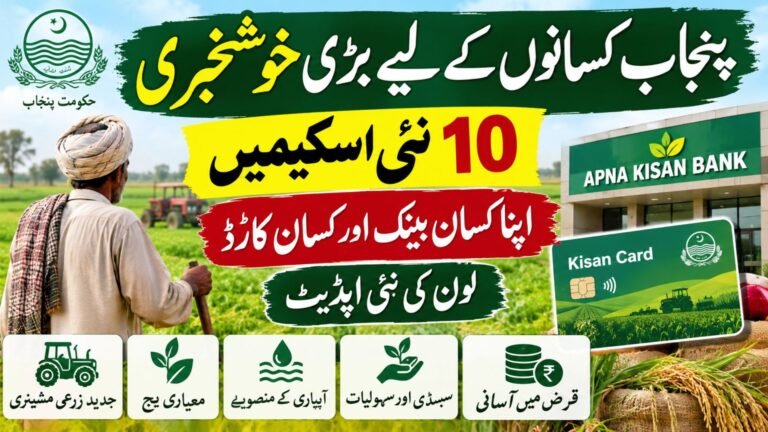

Punjab Farmers Initiatives 2026: Apna Kisan Bank, Rs17 Billion Loans, Kisan Card & Green Tractor Scheme
Apna Kisan Bank
Punjab farmers initiatives 2026 have become an important topic for small farmers, large landowners, agricultural businesses and people working in Pakistan’s farming sector. On October 28, 2026, Punjab Chief Minister Maryam Nawaz Sharif announced a new set of measures covering agricultural financing, Kisan Card support, wheat procurement, tractor subsidies, modern machinery, water management and agricultural exports. The announcement included plans for the province’s first Apna Kisan Bank and a subsidised agricultural loan package worth Rs17 billion. The government also announced an increase in the Kisan Card financing limit for purchasing DAP fertiliser, while outlining new plans to improve crop processing and farming facilities.
The Punjab farmers relief package 2026 is important because farmers face several connected challenges, including expensive fertilisers, seeds, machinery, irrigation costs, crop storage and changing market prices. Easier agricultural financing can help farmers purchase essential inputs on time, while better storage and processing facilities can reduce post-harvest losses and improve the value of their produce.
The latest announcements build on existing Punjab agriculture initiatives 2026 rather than replacing every earlier scheme. The Kisan Card, Green Tractor Scheme, water-efficient agriculture projects, agricultural machinery financing and Potohar development initiatives have their own programme rules and implementation schedules. Farmers should therefore check each scheme separately before applying.
Important distinction: The October 2026 announcements describe proposed or planned measures in several areas. An announcement does not automatically mean that applications are open, a bank is operational, or every farmer qualifies for assistance. The relevant government department must publish the applicable rules and application details.
More Read: 8558 Ramzan Package KPK 2027
Apna Kisan Bank Punjab: New Agricultural Financing Plan
The proposed Apna Kisan Bank Punjab is one of the main features of the new farmer support announcement. The plan aims to improve farmers’ access to agricultural credit and reduce the financial pressure associated with crop production, farm development and modern agricultural equipment.
Farmers often need money before harvesting because land preparation, fertiliser, seeds, pesticides, labour and irrigation must be paid for during the growing season. A suitable Punjab farmers loan scheme can help eligible applicants manage these expenses without relying entirely on informal borrowing or expensive commercial financing.
The October 28 announcement included a subsidised financing package worth Rs17 billion. The government said it would benefit farmers cultivating approximately five million acres. The financing arrangements reported by Dawn and Business Recorder included loans of up to Rs10 million at zero markup, up to Rs30 million at 2% interest and up to Rs50 million at 5% interest through the Punjab Urban Unit.
Apna Kisan Bank Loan Details
| Loan or financing category | Announced amount | Reported rate |
|---|---|---|
| Smaller agricultural financing category | Up to Rs10 million | 0% markup |
| Medium agricultural financing category | Up to Rs30 million | 2% interest |
| Larger agricultural financing category | Up to Rs50 million | 5% interest |
| Overall subsidised financing package | Rs17 billion | Rates vary by category |
| Reported intended coverage | Around 5 million acres | Subject to programme implementation |
These figures describe the announced financing plan, not a guarantee that every applicant can receive the maximum amount. The final loan limit, repayment period, security requirements, eligible farming activities and application procedure depend on the formal programme rules.
There is also an important reporting difference to understand. An Associated Press of Pakistan report published on October 28 described higher financing ceilings of Rs100 million, Rs300 million and Rs500 million under a different presentation of the proposed arrangement. APP report. Because this differs substantially from the figures reported by Dawn and Business Recorder, farmers should confirm the final approved loan tiers directly with the Punjab government before making financial decisions.
Apna Kisan Bank Eligibility and Registration
Many people are searching for Apna Kisan Bank eligibility, Apna Kisan Bank registration and the Apna Kisan Bank scheme 2026. However, the announcement alone does not establish a complete application process.
Before applying, farmers should look for an official notification explaining:
- Which landowners, tenant farmers and agricultural businesses can apply.
- Whether applicants must hold a Kisan Card or maintain a bank account.
- What land records, CNIC documents and farming information are required.
- Whether financing covers crop inputs, machinery, processing units or other agricultural investments.
- How the bank will assess applications, approve financing and collect repayments.
The phrase PAVET interest-free loan also appears among the agricultural financing search terms, but its connection to this announcement and its official eligibility conditions could not be independently verified. It should not be presented as a confirmed alternative registration route for Apna Kisan Bank.
Farmers looking for a zero markup loan for farmers or subsidised loans for Punjab farmers should use official government announcements rather than social media messages promising guaranteed approval. Until a formal application channel is published, Apna Kisan Bank registration should be treated as awaiting verified implementation details.
Punjab Farmers Loan Scheme 2026: What the Rs17 Billion Package Means
The Punjab agriculture loan 2026 announcement is intended to improve access to affordable financing for different categories of farmers. A small farmer who needs money for seeds and fertilisers has different financial needs from a commercial grower planning to buy machinery or establish a processing facility.
The Rs17 billion farmers loan package is therefore relevant to agricultural financing Punjab, especially where affordable credit can help farmers invest in their crops and improve productivity. Interest-free loans for farmers can reduce the cost of borrowing, while subsidised interest rates can make larger investments more affordable than financing at normal commercial rates.
However, the size of a loan is not the same as the amount of a subsidy. For example, a Rs10 million loan at zero markup is still a loan that may need to be repaid according to the final agreement. Farmers should check the repayment schedule, any collateral requirements and the total amount payable before signing documents.
The Punjab Urban Unit has been mentioned in reporting about the proposed financing structure. Applicants should wait for official instructions identifying the responsible institution, approved lenders and any designated online application portal.
The government has also linked its agricultural development plans with value addition, machinery production, irrigation improvements and export opportunities. These measures could support agricultural productivity Punjab if they are implemented effectively and reach farmers who need them most.
Kisan Card Scheme 2026: Loan Limit Increased to Rs33,500 Per Acre
The Punjab Kisan Card is an existing agricultural support programme, and the latest announcement includes an increase in the financing limit for purchasing DAP fertiliser. This is one of the most important updates for farmers preparing land and arranging fertiliser for their crops.
The Kisan Card scheme 2026 supports eligible farmers in purchasing approved agricultural inputs through the programme’s authorised arrangements. Government information about the existing scheme is available on the Punjab Agriculture Department’s Kisan Card page.
Kisan Card Loan Limit Comparison
| Detail | Previous reported limit | New announced limit |
|---|---|---|
| Kisan Card financing per acre | Rs30,000 | Rs33,500 |
| Increase per acre | — | Rs3,500 |
| Main purpose of the announced increase | — | DAP fertiliser financing |
The Kisan Card loan limit 2026 has increased by Rs3,500 per acre, from Rs30,000 to Rs33,500, according to the October 2026 announcement reported by Dawn and Business Recorder.
This Kisan Card loan increase is intended to help farmers manage higher input costs. It is particularly relevant to farmers purchasing diammonium phosphate, commonly known as DAP, which supplies phosphorus and nitrogen to crops.
Kisan Card Rs30,000 to Rs33,500: What Has Changed?
The change from Rs30,000 to Rs33,500 is an increase in the announced per-acre financing limit, not a cash payment of Rs3,500 to every farmer. Eligible farmers should confirm how the revised amount will be applied to their accounts and which purchases are permitted.
The Kisan Card subsidy and Kisan Card farmers benefits should also be understood correctly. Financing allows eligible farmers to purchase approved inputs under programme rules; it does not necessarily mean that all fertiliser, seed or pesticide purchases are free.
The existing scheme has been used to improve access to fertilisers, seeds and pesticides without requiring farmers to depend entirely on middlemen. The government has reported that more than one million small farmers benefit from the programme. The latest Kisan Card scheme update also highlights the government’s intention to improve digital disbursement and transparency.
Kisan Card Eligibility and Tenant Farmers
Kisan Card eligibility depends on the programme’s current requirements, which may include identity verification, land or cultivation records and other checks. Farmers should consult the Agriculture Department rather than assume that all applicants qualify automatically.
The government has also discussed steps to include tenant farmers and farmers cultivating land on lease. This is an important issue because some people actively grow crops but do not own the land they cultivate. The final rules must explain which tenancy or lease documents will be accepted and how cultivation will be verified.
For the latest Kisan Card Punjab 2026 information, farmers can visit the official Kisan Card portal. The portal provides programme information and links related to authorised dealers and other scheme resources. A farmer should not pay an unofficial agent simply to check eligibility or request registration.
Wheat Support Price 2026: Rs4,500 Per Maund
The wheat support price 2026 is another major issue in the latest Punjab farmers relief initiatives. During the October 28 announcement, the chief minister said the government would coordinate with the federal authorities to ensure implementation of the wheat support price of Rs4,500 per maund.
A support price is intended to provide a reference for wheat procurement and help farmers understand the government’s stated price policy. However, the practical benefit depends on the final procurement arrangements, eligibility rules, quantities accepted and the process through which farmers can sell their crop.
The Punjab wheat support price should therefore be read alongside the official wheat procurement policy and any formal procurement notification. Farmers should not assume that every buyer in the open market is legally required to purchase all wheat at the announced price unless the applicable policy says so.
Wheat Procurement Policy Punjab
A transparent wheat procurement plan Punjab can help farmers understand where to sell their produce, how to register, which documents are needed and how payments will be processed. The October announcement also included plans for an online portal to digitise wheat procurement.
Digitisation could improve recordkeeping, make procurement easier to monitor and help reduce unnecessary delays. Nevertheless, the launch date, portal address and application procedure should be confirmed through an official government notification.
The wheat cultivation loan issue is also important because farmers need working capital before the harvest. Interest-free wheat cultivation loans, if made available under an approved programme, could help cover seed, fertiliser, irrigation and other eligible production expenses. Farmers should confirm whether wheat-related expenses are covered under Apna Kisan Bank, Kisan Card or a separate agricultural financing programme.
Punjab wheat farmers relief also depends on timely procurement, reasonable transport costs, crop quality standards and reliable payments. A support price announcement alone cannot resolve every challenge faced by wheat growers.
Green Tractor Scheme 2026 and Agricultural Machinery Subsidies
The Green Tractor Scheme 2026 is part of the wider effort to improve farm mechanisation and make modern machinery more accessible. According to the October announcement, 25,000 tractors had already been provided to farmers on subsidy, and the government planned to expand the programme.
The Punjab Green Tractor Scheme should be distinguished from the separate high-tech agricultural mechanisation financing programme. A tractor subsidy reduces the eligible farmer’s purchase cost, while machinery financing generally involves a loan and repayment obligations under specific conditions.
The Agriculture Department’s published 2026–27 initiatives list a low-power Green Tractor Programme Phase IV targeting 10,000 tractors with a stated subsidy of Rs750,000 per tractor. The high-power programme Phase V targets 9,500 tractors with a stated subsidy of Rs1 million per tractor. These are programme targets and subsidy details published by the department, not proof that every applicant will receive a tractor.
Green Tractor Scheme Phase IV and Phase V
| Programme | Published target | Tractor power | Published subsidy |
|---|---|---|---|
| Green Tractor Scheme Phase IV, low power | 10,000 tractors | 50–65 HP | Rs750,000 per tractor |
| Green Tractor Scheme Phase V, high power | 9,500 tractors | 75–125 HP | Rs1,000,000 per tractor |
| Total published target | 19,500 tractors | Different power categories | Depends on programme |
These targets show how Punjab tractor subsidy scheme planning has developed beyond earlier phases. Farmers should not combine the figures for different phases and assume that applications for all phases are open at the same time.
The government has also announced Rs70 billion for high-tech agricultural mechanisation. The objective is to improve access to modern equipment, support local machinery manufacturing and encourage the production of tractors in the 85 to 100 HP range mentioned in the October announcement.
Agricultural Machinery Subsidy Punjab
High-tech agricultural mechanisation can support activities such as land preparation, sowing, spraying, harvesting and post-harvest handling. Agricultural machinery subsidy Punjab programmes may be particularly useful to farmers and agricultural service providers who cannot afford expensive equipment independently.
The government’s published Hi-Tech Farm Mechanization Financing Programme has its own requirements. Its published terms include a minimum 20% contribution toward machinery cost in approved cases, repayment through 20 equal quarterly instalments, and government payment of the interest cost. These terms belong to that specific programme and should not automatically be applied to the new Apna Kisan Bank announcement.
The broader Punjab farmers tractor scheme and farm machinery initiatives aim to improve access to equipment, reduce the time needed for field operations and support more efficient farming practices. Plans to establish agricultural machinery factories Punjab and encourage local tractor production may also create opportunities for manufacturers, repair businesses and skilled workers.
Farmers should verify the eligible horsepower category, landholding conditions, application window and subsidy amount from the official scheme advertisement. Published programme requirements can differ between low-power and high-power tractors.
Punjab Agro-Parks 2026: Sargodha, Bhakkar, Khanewal and Okara
The Punjab agro-parks proposal focuses on improving the way agricultural products are handled after harvesting. Farmers can lose part of their earnings when fruit, vegetables and other crops are damaged, stored poorly or sold without suitable grading and processing facilities.
The October announcement identified four proposed locations: Sargodha agro-park, Bhakkar agro-park, Khanewal agro-park and Okara agro-park. The aim is to improve agricultural value addition Punjab and strengthen the potential for selling processed products in domestic and international markets.
The proposed facilities are expected to support grading, storage and processing of products such as mangoes, kinnows, oranges and potatoes. However, the final locations, construction schedule, operating arrangements and services available to farmers require official confirmation.
Agricultural Value Addition and Exports
Agricultural value addition means improving a raw product’s market value through processing, packaging, storage, grading or manufacturing. For example, fruit can be sorted and packed to meet market standards, while potatoes can be processed into products for food businesses.
Better mango processing and storage can help growers manage seasonal supply and reduce avoidable waste. Kinnow processing facilities and improved orange storage can support the citrus supply chain, while potato processing facilities may create opportunities for food manufacturers and exporters.
Wheat value-added products are another area mentioned in the government’s agricultural development plans. The chief minister indicated that Punjab would explore exporting products such as pasta following an increase in wheat production. Such exports depend on product quality, processing capacity, international demand and compliance with importing countries’ standards.
Agricultural exports Pakistan can benefit when growers, processors, transport companies and exporters work through an efficient supply chain. The proposed agro-parks in Punjab are intended to support that process, but the expected export value or number of new jobs should not be treated as confirmed until project-level data is published.
Punjab Water Management Initiatives and Irrigation Improvements
Water availability and distribution are essential to agricultural productivity Punjab. A farmer may have access to suitable land and fertiliser but still face poor yields if irrigation water is unreliable or used inefficiently.
The latest Punjab water management initiatives include action against water theft and efforts to improve the delivery of canal water to farmers at the tail end of irrigation channels. Water theft in Punjab agriculture can affect farmers who depend on a fair share of available supplies, particularly during periods of high demand.
Punjab canal water distribution requires effective monitoring, maintenance of channels and transparent enforcement. Farmers should report problems through the relevant irrigation authorities rather than rely on unverified claims about individual enforcement operations.
High-Efficiency Irrigation and Watercourse Lining
High-efficiency irrigation systems can help reduce water losses and improve the delivery of water to crops. Punjab’s published agriculture programmes include support for water-efficient agriculture and watercourse improvements, although the subsidy rate and eligibility conditions depend on the particular project.
Watercourse lining Punjab projects can reduce seepage in suitable locations and improve water conveyance. The government’s Punjab Resilient and Inclusive Agriculture Transformation project and other water-management initiatives have separate implementation requirements.
The government has also been working on water conservation and groundwater recharge in areas where rainfall and water availability are less reliable. These measures are particularly relevant to farmers in rain-fed and water-scarce regions.
Potohar Mini Dams and the Potohar Transformation Package
The October 2026 announcement stated that around 400 mini-dams had been completed in the Potohar region, with a target of increasing the number to 1,000. These figures are based on the reported announcement and should be checked against subsequent official progress updates.
Potohar mini dams can help capture and store rainwater for agricultural and other local uses. The Potohar Transformation Package also supports agricultural development in the region through initiatives that include olive cultivation and water-related infrastructure.
Potohar olive cultivation is important because olive orchards can provide an alternative agricultural activity in suitable areas. Olive farming subsidy Punjab programmes may support orchard establishment and related infrastructure, but farmers must check the current application notice for the exact subsidy and requirements.
Olive oil extraction facilities can help farmers and local businesses process olives into higher-value products. The commercial benefit depends on suitable varieties, orchard management, harvesting, processing capacity and market access.
Soil Fertility Testing Laboratories and Water Quality Testing
Soil fertility testing laboratories help farmers understand the nutrient condition of their fields and choose fertilisers according to their soil’s needs. Mobile soil testing labs Punjab can make testing services more accessible in areas where farmers have difficulty travelling to a laboratory.
The Punjab Agriculture Department lists divisional and district laboratories that provide soil, water and plant analysis services. Farmers can submit samples and receive reports with fertiliser recommendations through the department’s established services.
Water quality testing laboratories are also important because irrigation water quality can influence soil health, crop growth and long-term farm productivity. Testing results can help farmers make informed decisions rather than applying inputs without understanding their fields’ actual requirements.
These services form part of the wider Punjab irrigation improvement scheme and agricultural extension services. Farmers should contact their local agriculture office to confirm the nearest testing facility and sample submission procedure.
Other Punjab Farmer Support Schemes and Agricultural Development Plans
The Punjab farmers relief package 2026 is not limited to loans and tractors. The province’s wider agricultural development programme also includes support for water-efficient farming, livestock, crop management, technical guidance and rural productivity.
Punjab Small Farmers Support
Punjab small farmers support is particularly important because smaller growers may have fewer savings and less access to commercial credit. The Kisan Card, eligible subsidised financing and tractor subsidy programmes can help address some of these challenges, provided the benefits reach farmers under transparent rules.
The government has also discussed including tenant farmers and people cultivating leased land in the Kisan Card programme. Formal eligibility rules will determine which farmers qualify and what documents they must submit.
Punjab Livestock Farming and Livestock Fattening Scheme
Punjab livestock farming contributes to rural household income and the wider agricultural economy. Livestock fattening scheme Punjab initiatives can help farmers and livestock businesses improve animal management, feeding and market readiness.
Farmers should check the relevant Livestock and Dairy Development Department announcements for current financing, animal eligibility and application details. Livestock support programmes have their own conditions and should not be assumed to fall automatically under Apna Kisan Bank.
Agricultural Extension Services
Agricultural extension services provide practical guidance on crop selection, pest control, fertiliser use, irrigation, seed quality and improved farming methods. These services can help farmers understand how to use available resources efficiently and respond to changing weather or crop conditions.
The Agriculture Department’s field staff and research services can also help farmers interpret soil test results, identify crop problems and learn about recommended agricultural practices. Access to reliable technical advice is an important part of Punjab farmers development package planning.
Agricultural Productivity Punjab and Farming Modernisation
Agricultural productivity Punjab depends on several factors working together, including timely access to credit, quality inputs, suitable machinery, reliable irrigation, technical guidance and markets that reward good-quality produce.
Punjab farming modernisation is therefore broader than distributing tractors or announcing loans. Modernisation also requires better information, efficient supply chains, post-harvest facilities, suitable technology and responsible management of natural resources.
The province’s agricultural development plans seek to improve farm efficiency and strengthen the connection between production, processing and marketing. Their long-term value will depend on implementation, access for small farmers and measurable improvements in productivity and income.
Crop Residue Management and Smog Prevention Punjab Farmers
Crop residue management is another important issue during the agricultural season. Burning leftover crop material can contribute to air pollution and smog, especially when combined with emissions from transport, industry and other sources.
Smog prevention Punjab farmers initiatives encourage growers to avoid open burning and consider suitable residue-management practices. Depending on the crop and available machinery, farmers may be able to manage residues through incorporation, collection or other approved techniques.
Access to affordable equipment and practical guidance is important because farmers need workable alternatives, not just instructions to stop burning. Modern agricultural machinery, extension services and suitable residue-management methods can help reduce environmental damage while keeping farming operations practical.
What Changed from 2025 to 2026?
Punjab’s agricultural support system has developed through several programme phases. The 2025–26 financial year included existing schemes and projects for tractors, farm mechanisation, Kisan Card financing and water management. The 2026–27 programme information published by the Agriculture Department shows continuing and expanded initiatives rather than a complete replacement of the previous year’s support system.
| Area | Earlier or existing programme position | 2026–27 development or announcement |
|---|---|---|
| Kisan Card | Existing interest-free agricultural input financing programme | Phase II programme targets one million cardholders, with loans up to Rs360,000 per cropping season in the published scheme plan |
| Tractor support | Earlier Green Tractor Scheme phases operated under separate rules | Phase IV targets 10,000 low-power tractors and Phase V targets 9,500 high-power tractors |
| Agricultural loans | Existing financing programmes serve specific farming needs | New Apna Kisan Bank proposal and Rs17 billion subsidised financing announcement |
| Kisan Card DAP financing | Previously reported limit of Rs30,000 per acre | October announcement raised the stated limit to Rs33,500 per acre |
| Farm machinery | Existing machinery support and financing projects | Rs70 billion high-tech mechanisation allocation reported in the October announcement |
| Water management | Existing watercourse, irrigation and water-conservation projects | Continued water management focus, including reported Potohar mini-dam targets |
| Crop processing | Existing agricultural supply chains and value-addition initiatives | Proposed agro-parks in four districts to support grading, storage and processing |
The Agriculture Department’s published initiative list identifies Kisan Card Phase II for 2026–27 to 2027–28, with a target of one million cardholders and loans up to Rs360,000 per cropping season for three cropping seasons. It also lists the two Green Tractor programme phases and their separate targets. These published programme details should be read independently from the newly announced Apna Kisan Bank financing structure.
The comparison is useful because farmers often encounter older figures in search results and social media posts. A figure from an earlier phase should not be presented as the current limit without checking the date and the programme to which it belongs.
How to Check Punjab Farmers Scheme Eligibility and Apply
Farmers looking for Punjab farmers initiatives 2026 should begin with the official Agriculture Department website and identify the exact programme they want to join. Kisan Card registration, tractor applications, machinery financing and the proposed Apna Kisan Bank are separate matters, and each may have different eligibility rules.
Before submitting an application, farmers should:
- Check the latest official advertisement or notification for the relevant scheme.
- Confirm whether applications are currently open and note the closing date.
- Review the landholding, cultivation, tenancy or business requirements.
- Prepare the CNIC, land records, bank information and other documents specifically requested by the scheme.
- Use only the official application portal or the authorised office named in the notification.
- Read the loan amount, markup, repayment schedule and security conditions before accepting financing.
For Kisan Card information, use the Punjab Agriculture Department’s official page. For Green Tractor Scheme information, consult the official tractor programme page. For high-tech machinery financing, check the official mechanisation programme.
As of the October 29, 2026 reporting date, the announcement of Apna Kisan Bank should not be treated as proof that a public registration portal is open. Farmers should wait for verified instructions on the bank’s launch, application dates and final loan conditions.
Important Note for Farmers
The amounts and targets in this article are based on the published Punjab Agriculture Department programme information and reports about the October 28, 2026 announcements. Proposed projects, approved budget allocations, programme targets and benefits already delivered are different categories of information.
The reported Rs17 billion financing package is not the same as a direct cash grant to every farmer. The announced Kisan Card limit of Rs33,500 per acre relates to financing for DAP fertiliser and should not be interpreted as an unconditional cash payment. Tractor subsidies depend on the relevant programme’s eligibility rules, available allocations and selection process.
There is also a discrepancy between some news reports about the proposed Apna Kisan Bank loan ceilings. Farmers should rely on the final government notification and confirmed lender instructions before borrowing, paying a registration fee or sharing sensitive documents. No unverified website, WhatsApp message or private agent should be treated as an official registration channel.
Frequently Asked Questions
1. What are the latest Punjab farmers initiatives 2026?
The October 28 announcement covered the proposed Apna Kisan Bank, Rs17 billion in subsidised agricultural financing, a higher Kisan Card DAP financing limit, wheat procurement measures, tractor subsidies, high-tech mechanisation, agro-parks, water management and olive cultivation support.
2. What is Apna Kisan Bank Punjab?
Apna Kisan Bank is a proposed agricultural financing initiative announced by the Punjab chief minister on October 28, 2026. The aim is to improve farmers’ access to affordable loans. Farmers should check official notices for its operational status and application procedure.
3. What is the new Kisan Card loan limit in 2026?
The October announcement increased the reported DAP fertiliser financing limit from Rs30,000 to Rs33,500 per acre, an increase of Rs3,500. Farmers should confirm the effective date and account-level application of the revised limit.
4. How much money is included in the Punjab farmers loan package?
The announced subsidised agricultural financing package is worth Rs17 billion and is intended to support farmers cultivating around five million acres. Individual loan amounts and interest rates depend on the final financing rules.
5. What is the wheat support price announced in October 2026?
The chief minister said the government would coordinate with the federal authorities to ensure implementation of a wheat support price of Rs4,500 per maund. Farmers should check the official procurement policy for practical selling and registration arrangements.
6. How many tractors are included in the published Green Tractor targets for 2026–27?
The Punjab Agriculture Department’s published targets list 10,000 low-power tractors under Phase IV and 9,500 high-power tractors under Phase V, making a combined target of 19,500 tractors across those two phases.
7. Can tenant farmers apply for the Kisan Card?
The government has discussed including tenant farmers and farmers cultivating leased land. Eligibility depends on the final applicable rules and the documents accepted to verify cultivation.
8. Is Apna Kisan Bank registration open?
The October 2026 announcement does not, by itself, confirm that public registration is open. Farmers should use an official government notification to verify the launch date, application channel and eligibility requirements.
Conclusion
Punjab farmers initiatives 2026 cover several areas that directly affect farming costs, crop production and the ability to sell agricultural products. The proposed Apna Kisan Bank and Rs17 billion financing package are intended to improve access to credit, while the revised Kisan Card limit offers a higher reported financing ceiling for DAP fertiliser. Published Green Tractor Scheme targets, the high-tech mechanisation programme, proposed agro-parks and water-management projects form part of the province’s wider agricultural development effort.
For farmers, the most important next step is to distinguish an announcement from an operational scheme. Check the official Agriculture Department pages, confirm current eligibility and application dates, and read the final loan or subsidy conditions before making financial commitments. Reliable information will help farmers make better decisions and avoid confusion caused by outdated figures or unverified registration claims.
Source Table: Official and Trusted References
| Source | Purpose | Direct Link |
|---|---|---|
| Punjab Agriculture Department | Official schemes, Kisan Card and agricultural initiatives | Visit website |
| Punjab Kisan Card | Scheme information and authorised dealers | Official Kisan Card page |