
SBP Small Business Loans 2026 – How to Apply Online Through SMEConnect
SBP Small Business Loans 2026
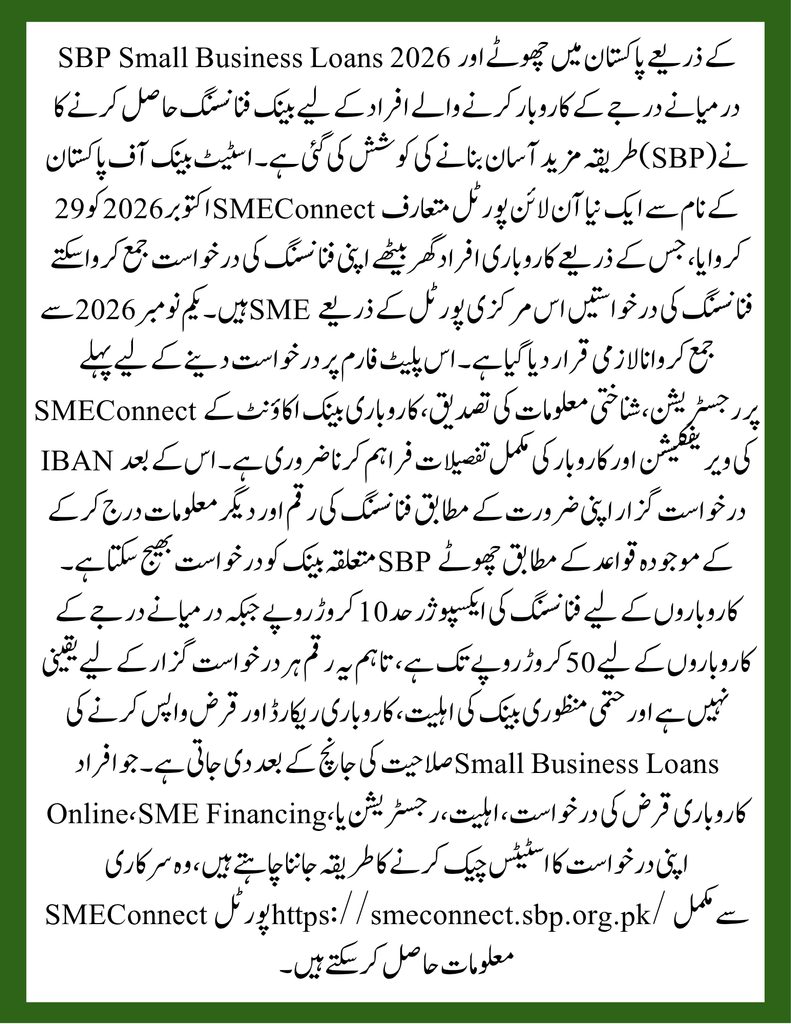
Small businesses play an important role in Pakistan’s economy, but getting bank financing has not always been easy for shopkeepers, manufacturers, service providers, and new entrepreneurs. Many business owners face difficulties understanding bank requirements, preparing applications, and finding the right financial institution. To make this process more organised, the State Bank of Pakistan (SBP) has introduced a new digital platform called SMEConnect.
Through this platform, eligible Small and Medium Enterprises (SMEs) can submit financing applications online and connect with banks and Development Finance Institutions (DFIs). Instead of approaching different banks to submit separate applications, business owners can now use one centralised platform to start their financing request.
The State Bank announced the launch of SMEConnect on October 29, 2026, through SH&SFD Circular No. 08 of 2026. Under the new instructions, all SME financing applications must be submitted through this portal from November 1, 2026.
This guide explains how to apply for small business loans through SBP online, who may qualify, how to complete SMEConnect registration, which business details are required, and how to track an application. It also explains the previous 2025 financing framework and the important changes introduced during 2026, so applicants can understand the current process before submitting their requests.
More Read: Punjab PIVOT Program 2026
BP Small Business Loans 2026 – Quick Information
| Information | Details |
|---|---|
| Program / Platform | SMEConnect |
| Introduced By | State Bank of Pakistan (SBP) |
| Launch Date | 29 October 2026 |
| Application Start Date | 1 November 2026 |
| Official Website | https://smeconnect.sbp.org.pk/ |
| Target Applicants | Small and Medium Enterprises (SMEs) |
| Application Method | Online |
| Registration Fee | Check official portal |
| Small Enterprise Financing Limit | Up to Rs. 100 Million |
| Medium Enterprise Financing Limit | Up to Rs. 500 Million |
| Bank Account Verification | Through Business IBAN |
| Financing Options | Conventional and Islamic financing, subject to bank availability |
| Application Process | Registration, IBAN Verification, Business Profile and Financing Request |
| Application Tracking | Through SMEConnect Dashboard |
| Loan Approval | Subject to bank or DFI assessment |
| Support Email | smeconnect@sbp.org.pk |
| SBP Helpline | +92 21 111 727 273 |
| Complaint Portal | SBP Sunwai |
What Are SBP Small Business Loans and How Does SMEConnect Work?
SBP small business loans are bank financing facilities offered to eligible small and medium-sized businesses under the regulatory framework of the State Bank of Pakistan. These facilities can help businesses meet their financial needs, such as purchasing machinery, increasing production, managing working capital, buying business equipment, or expanding existing operations.
However, one important point needs to be understood: SBP does not directly provide every business owner with a personal loan through SMEConnect. The portal connects applicants with banks and DFIs, while the financial institution reviews the application and decides whether financing can be approved.
SMEConnect is designed to make SME financing applications more accessible and easier to monitor. It provides a central digital channel where businesses can register, verify their bank accounts, enter their business information, request financing, and check application progress.
The official portal is available here:
SMEConnect Official Website: https://smeconnect.sbp.org.pk/
The platform is particularly useful for entrepreneurs who are searching for Small Business Loans Online because it provides a single place to begin the application process instead of relying on separate online forms from different financial institutions.
What Changed in SBP SME Financing Between 2025 and 2026?
The SME financing system has gone through important regulatory and digital changes. Understanding these developments is useful for business owners who may have previously applied for financing through a bank branch or an individual bank website.
Previous SME Financing Rules in 2025
On November 6, 2025, the State Bank of Pakistan issued SH&SFD Circular No. 05 of 2025, introducing revised Prudential Regulations for Small and Medium Enterprise Financing. These regulations became applicable from January 1, 2026.
Under the earlier arrangement, banks and DFIs were required to provide standardised and simplified financing application forms. They were also required to make digital application facilities available to SME borrowers, alongside paper-based applications.
The regulatory framework also included financing exposure limits of up to Rs. 100 million for small enterprises and Rs. 500 million for medium enterprises, subject to the applicable rules and the financial institution’s assessment.
This arrangement helped establish a more organised application system, but applicants could still need to deal with different bank channels.
New SMEConnect System Introduced in 2026
The biggest development came on October 29, 2026, when SBP officially announced SMEConnect as its centralised SME financing portal.
The new system changed the way businesses submit their financing requests. From November 1, 2026, SME financing applications must be submitted through SMEConnect and will be forwarded to the relevant bank or DFI after necessary verification.
Banks and DFIs have also been instructed to display the SMEConnect link on their websites and mobile applications. Applicants visiting bank branches for financing assistance must be guided towards completing their applications digitally through the portal.
This means the new system is not simply another Business Loan Online website. It is now the central application channel for SME financing under SBP’s instructions.
More Read: Apna Kisan Bank Loan Apply Online 2026
Latest SME Definition Updated in July 2026
Another important development took place on July 16, 2026. SBP revised the annual sales turnover criteria used to classify micro, small, and medium enterprises.
The updated categories are important because businesses need to understand their classification before checking their financing eligibility.
| Enterprise Category | Annual Sales Turnover |
|---|---|
| Micro Enterprise | Up to Rs. 30 million |
| Small Enterprise | Above Rs. 30 million to Rs. 400 million |
| Medium Enterprise | Above Rs. 400 million to Rs. 2 billion |
| Start-up | Micro, small, or medium enterprise up to 5 years old |
These updated definitions help financial institutions classify businesses under the current regulatory framework. They do not mean that every business within these sales limits automatically qualifies for financing.
Who Can Apply for Small Business Loans Through SBP Online?
Businesses that fall within the applicable SME categories may apply for financing through SMEConnect. However, registration and eligibility are two different things. Creating an account does not automatically make an applicant eligible for a loan.
Generally, the platform is intended for businesses that can provide genuine business information and meet the requirements of the bank or DFI reviewing their request.
Potential applicants include:
- Small shop owners and retailers who need financing to increase their stock or improve their business operations.
- Manufacturers who want to purchase machinery, equipment, or raw materials.
- Service providers who need funds to improve their facilities or expand their services.
- Traders and wholesalers who require working capital for regular business activities.
- Small business owners who want to expand an existing business.
- Eligible start-ups that fall within SBP’s SME classification and meet the selected bank’s financing requirements.
Applicants should also be prepared to provide their CNIC details, a valid mobile number, an email address, a business bank account, and accurate business information.
Small Business Loan Eligibility Criteria
The Small Business Loan Eligibility Criteria are not based on one condition alone. The bank or DFI may examine several factors before making a decision.
These may include:
- Whether the business falls within the applicable SME classification.
- Whether the applicant’s identity and business details can be verified.
- Whether the business has a suitable bank account and valid IBAN.
- Whether the business generates sufficient income to support repayment.
- Whether the requested financing amount matches the business’s actual requirements.
- Whether the applicant meets the bank’s credit assessment and documentation requirements.
- Whether the proposed financing activity is allowed under the selected bank’s financing policy.
A business with complete information may have a smoother application process, but final approval remains subject to the bank’s assessment.
How to Apply for Small Business Loans Through SBP Online in 2026
Business owners can start their online application through the official SMEConnect portal. The process involves account registration, bank account verification, business profile completion, and submission of a financing request.
Here is a step-by-step explanation of the process.
Step 1: Visit the Official SMEConnect Portal
First, open the official website:
Check the information displayed on the homepage before starting your application. The portal provides information about SME financing, eligibility, the application process, and useful links to relevant institutions.
New applicants need to create an account, while existing users can access their accounts through the login option.
Always check that you are using the official SBP website before entering your personal or business information.
Step 2: Complete SMEConnect Online Registration
For SMEConnect Online Registration, new users should select the registration option available on the portal.
The registration form asks for basic personal information, including:
- Full name
- Mobile number
- Email address
- Gender
- CNIC number
- Password
After entering the required information, accept the terms and conditions and submit the registration form.
The portal sends a verification code to the registered mobile number or email address. Enter the security code to complete the registration process.
Keep your registered mobile number and email address active because they may be used for verification and future communication.
Step 3: Complete Business Bank Account Verification
After registration, the next important step is Business Bank Account Verification.
Applicants need to enter the IBAN of the bank account mainly used for their business transactions. The portal uses the IBAN to identify the relevant bank and verify the account information.
Business IBAN Verification is an important part of the process because the financial institution needs accurate banking details when reviewing the financing request.
If you have accounts with more than one bank, provide the IBAN of the account from which you want to receive the financing.
If you do not have a suitable bank account, you should contact your preferred bank and arrange an appropriate account before continuing.
Make sure the IBAN is entered correctly. An incorrect or inactive account number may create difficulties during verification or further processing.
Step 4: Enter Your Business Information
Once the bank account is verified, the portal allows applicants to enter their business details.
This information helps the bank understand the nature, size, location, and financial position of the business.
The information requested includes:
- Business name
- Business owner’s CNIC
- Business email address
- Nature of business
- National Tax Number (NTN)
- Business status
- Business address
- Year of establishment
- Annual sales
- Business premises
- Registration authority
Enter the information carefully and make sure it matches your available business records.
After completing the form, select the Save & Continue option. Review the business profile summary before confirming the information.
The portal then provides access to the applicant’s dashboard, where different application stages can be monitored.
Step 5: Apply for New Financing
After completing the business profile, open your dashboard and select the Apply for New Financing option.
The financing application is divided into three main stages:
Business Information: Review the business details already entered in your profile and make sure they are correct.
Financing Details: Select the required financing mode and enter the amount you need. You may also need to provide the requested financing tenure and other details shown in the application.
Review: Check the information before submitting your request to the selected financial institution.
Applicants should request an amount that matches their actual business requirements and expected repayment capacity. Asking for an unnecessarily large amount may make the application harder to justify during the bank’s assessment.
Step 6: Select Financing Mode and Submit Your Application
The financing section allows applicants to enter the required financing details. One of the options demonstrated in the SMEConnect tutorial is Islamic financing.
Applicants should carefully review the available financing options and select the one that suits their business requirements.
Once all the details are complete, review the application again. If you are not ready to submit it, you can save it as a draft and return later.
When everything is correct, select Submit Application, read the undertaking, and use the Agree & Submit option to complete the process.
The portal then generates an application reference containing details such as the case ID, submission date, assigned bank, and application status.
Keep the reference information safe because it will help you follow up on your financing request.
How to Track SME Loan Application Status Online
After submitting a request, applicants do not need to start a new application just to check its progress.
The portal provides a Track Application option that allows users to monitor their financing requests.
Applicants can check the progress through the dashboard, which displays different stages of the application.
| Application Status | What It Means |
|---|---|
| Draft | The application has been saved but not submitted. |
| Submitted | The financing request has been submitted. |
| Under Review | The application is being examined. |
| Approved | The bank has approved the financing request. |
| Rejected | The financing request has not been approved. |
| Disbursed | The approved financing has been released. |
The SME Financing Application Status can help applicants understand what is happening after submission.
If the bank requires additional details or documents, it may contact the applicant using the registered mobile number or email address.
Applicants should regularly check their dashboard and respond to any communication from the relevant bank.
What Happens If a Bank Rejects Your Application?
A rejected application does not mean that every future financing request will automatically be rejected.
Applicants should first review the reason provided by the financial institution, where available. Possible reasons may include incomplete documentation, insufficient repayment capacity, incorrect business information, or failure to meet the bank’s financing requirements.
Correct the relevant issue before considering another application. If the reason is unclear, contact the assigned bank and request further guidance.
What Is the Maximum Business Loan Amount Under SBP Regulations?
One of the most common questions among business owners is how much financing they can receive through the SME system.
SBP’s Prudential Regulations provide per-party exposure limits for different enterprise categories. Under the applicable framework, the regulatory limits are:
| Enterprise Category | Financing Exposure Limit |
|---|---|
| Small Enterprise | Up to Rs. 100 million |
| Medium Enterprise | Up to Rs. 500 million |
These figures are regulatory exposure limits, not guaranteed loan offers or fixed amounts that every applicant can receive.
The actual Business Loan Amount depends on the business category, financing requirements, repayment capacity, available financial records, and the bank’s credit assessment.
For example, a small retailer requesting Rs. 2 million to increase business stock will be assessed according to the bank’s lending policy and financial requirements. A manufacturer requesting Rs. 50 million for machinery may face a different assessment because the purpose, business size, and repayment structure are different.
Therefore, applicants should not assume that the maximum regulatory limit will be approved automatically.
Is Islamic Financing Available Through SMEConnect?
Yes, Islamic Financing is among the financing modes demonstrated in the SMEConnect application tutorial.
Business owners who prefer Shariah-compliant financing should check the available options offered by their selected Islamic bank or Islamic banking institution.
Islamic business financing may use different structures depending on the nature of the transaction and the financial product. These can include arrangements such as Murabaha, Ijarah, or other Shariah-compliant financing structures offered by the institution.
The exact financing terms, profit rate, repayment schedule, security requirements, and approval conditions depend on the selected bank and its product.
Applicants should ask the bank for complete details before accepting any financing offer.
What Documents Should You Prepare Before Applying?
The SMEConnect registration process collects personal, banking, and business information. However, the bank may require additional documents when assessing the financing request.
Preparing the relevant records before starting an application can help reduce mistakes and delays.
Commonly useful documents and information include:
- Valid CNIC of the business owner or authorised representative.
- Active mobile number and email address.
- Business bank account and IBAN.
- NTN and available tax records.
- Business registration documents, where applicable.
- Business address and premises information.
- Annual sales and financial records.
- Bank statements, if requested by the financial institution.
- Details of the required financing and its intended business purpose.
- Any additional documents requested by the selected bank.
This is a preparation checklist, not a universal official document list. The exact requirements can vary according to the business type, financing product, and bank.
SMEConnect Login: How to Access Your Account Again
Applicants who have already registered can use the SMEConnect Login option to access their accounts.
Enter the registered email address and password. The portal may then send a six-digit OTP to the registered mobile number or email address for additional verification.
If you forget your password, use the Forgot Password option to start the password recovery process.
Always keep your login information private. Do not share your OTP, password, or account access with an unknown person claiming to offer guaranteed financing.
SBP Helpline and Complaint Support
Applicants who face problems during registration, IBAN verification, or financing application submission can seek assistance through the available support channels.
The SMEConnect portal lists the following contact details:
| Support Detail | Information |
|---|---|
| Official Portal | https://smeconnect.sbp.org.pk/ |
| Email Address | smeconnect@sbp.org.pk |
| Helpline | +92 21 111 727 273 |
| Complaint Platform | SBP Sunwai Portal |
For complaints about banking services, applicants can also use the SBP Sunwai Portal or its mobile application.
The SBP Sunwai Portal provides a channel for customers to submit and follow up on complaints related to financial institutions. Applicants should first contact the relevant bank when the issue concerns a specific financing application.
What Should Business Owners Expect in 2027?
The introduction of SMEConnect in November 2026 provides a new digital route for businesses seeking financing from banks and DFIs. As businesses move into 2027, the centralised application system is expected to remain an important part of the SME financing process under the current SBP instructions.
However, applicants should distinguish between an existing regulatory arrangement and a newly announced government loan scheme.
As of November 1, 2026, the launch of SMEConnect does not establish a separate nationwide grant, interest-free loan programme, or guaranteed financing amount for 2027.
Business owners looking for financing in 2027 should continue checking the official SMEConnect portal and their selected bank’s announcements for updated products, financing conditions, and application requirements.
Any new loan amount, subsidy, repayment period, or government support facility should only be considered confirmed when it is announced through an official source.
Important Notes Before Submitting Your SME Loan Application
Before applying for financing, business owners should keep the following points in mind:
- Always use the official SMEConnect website for registration and application submission.
- SMEConnect is a centralised application platform, not a direct loan-disbursement department.
- Registration does not guarantee financing approval.
- The relevant bank or DFI makes the final lending decision.
- Provide correct CNIC, business, sales, and banking information.
- Verify your IBAN before submitting the financing request.
- Check the repayment terms, profit rate, fees, and security requirements with the bank.
- Save your application reference and regularly check its status.
- Never pay an unauthorised agent who promises guaranteed approval.
Applicants should also remember that the availability of a financing product does not mean every applicant will qualify for it. The bank must complete its assessment before making a final decision.
Frequently Asked Questions (FAQs)
1. How to Apply for Small Business Loans Through SBP Online?
Visit the official SMEConnect portal, register an account, verify your business bank account through IBAN, complete your business profile, enter financing details, and submit the application to the relevant bank or DFI.
2. Is SMEConnect an Official State Bank of Pakistan Portal?
Yes. SMEConnect is the centralised SME financing portal launched by the State Bank of Pakistan on October 29, 2026. Its official website is smeconnect.sbp.org.pk.
3. When Did SMEConnect Become Mandatory?
According to SBP’s SH&SFD Circular No. 08 of 2026, all SME financing applications must be submitted through SMEConnect from November 1, 2026.
4. Can I Apply for a Small Business Loan Without a Bank Account?
The application process includes verification of a business bank account through IBAN. Applicants who do not have a suitable account should contact a bank to arrange one before proceeding.
5. What Is the Maximum SME Financing Limit in Pakistan?
Under the applicable SBP exposure limits, small enterprises can access financing facilities of up to Rs. 100 million, while medium enterprises can access up to Rs. 500 million. These are regulatory limits, not guaranteed approval amounts.
6. How Can I Check My SME Loan Application Status?
Log in to SMEConnect and use the Track Application option to check whether your application is in draft, submitted, under review, approved, rejected, or disbursed.
7. Can I Apply for Islamic Business Financing Online?
Yes. Islamic financing is among the financing modes demonstrated on SMEConnect. Actual availability and terms depend on the selected financial institution.
8. Can a New Business or Start-up Apply for SME Financing?
A business that is up to five years old may fall within SBP’s start-up classification if it meets the applicable SME category requirements. However, the bank will assess its business information, financial position, and repayment capacity before approving financing.
9. Is SMEConnect Available in Urdu?
The platform’s application guidance is available in English and Urdu, helping business owners understand the registration and financing process.
10. Will SBP Introduce a New Small Business Loan Scheme in 2027?
No separate 2027 scheme or new guaranteed loan amount is confirmed through the SMEConnect launch announcement. Applicants should follow official SBP and bank updates for any future programme.
Conclusion
The launch of SMEConnect is an important development for small and medium-sized businesses seeking bank financing in Pakistan. It provides one central digital platform for submitting financing requests and monitoring their progress instead of relying on separate application channels at different banks.
Business owners who want to apply for Small Business Loans Online should first check their SME classification, prepare accurate business information, verify their bank account, and complete the application through the official portal.
The most important thing to remember is that SMEConnect makes the application process more organised, but it does not guarantee approval. Every financing request remains subject to the relevant bank or DFI’s assessment, eligibility requirements, and repayment conditions.
For the latest information, applicants should use the official SMEConnect portal and check SBP’s updated regulations before making any financial decision.
Official and Trusted Sources Table
| Source | Information Verified | Official Source / Report |
|---|---|---|
| State Bank of Pakistan (SBP) | SMEConnect launch, mandatory application date, revised SME definitions, annual sales limits and SME financing regulations | Official SBP Circulars & Prudential Regulations |
| SMEConnect | Online financing application portal | Official SMEConnect Website |
| ProPakistani | Registration, IBAN verification and application instructions | Read Full Report |
| Dawn | SMEConnect launch and November 1 implementation | Read News Report |